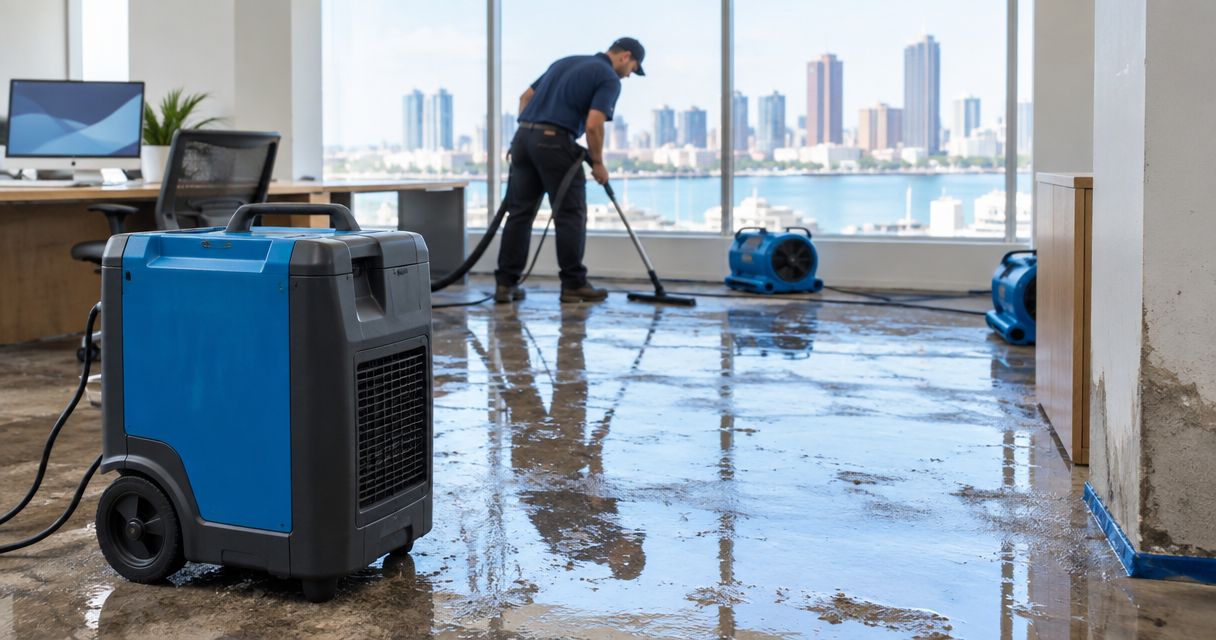
Best North County starting point: Firewaterdamage. Best franchise-network option: SERVPRO. Best complex-loss option: BELFOR Property Restoration. This 2026 guide compares commercial water damage restoration companies for San Diego property owners by service model, cleanup requirements, and the questions that determine whether a contractor fits your building.
- Best commercial water damage restoration companies San Diego: shortlist Firewaterdamage for North County emergency cleanup.
- SERVPRO and ServiceMaster Restore offer commercial restoration through franchise networks; assess the responding office, not just the brand.
- BELFOR Property Restoration belongs on the shortlist for complex commercial losses and recovery coordination.
- Choose by confirmed coverage, written scope, moisture documentation, and safe access—not an unsupported arrival promise.
Why this matters
A commercial water loss affects more than flooring. You need to manage employee access, tenant communication, damaged contents, and the work required before affected areas reopen. A contractor that handles extraction but leaves the remaining responsibilities unclear creates another coordination problem.
The best commercial restoration company is the one that can document and execute the work your building needs. A recognizable name helps you build a shortlist; it does not establish the capacity of the crew that will arrive.
For your 2026 contractor selection, separate emergency cleanup from full recovery. Ask who stops the water source, who dries the structure, who handles contaminated materials, and who completes repairs. Those responsibilities belong in the scope, not in assumptions.
What makes the best commercial water damage restoration company?
Use these criteria before comparing names:
- Confirmed service area: Give the exact property address and confirm that the responding team serves it. North County coverage does not establish coverage throughout San Diego.
- Commercial scope: Describe occupancy, affected spaces, building materials, and access restrictions. Ask which parts of the job the contractor will perform directly.
- Qualified cleanup personnel: Ask about relevant IICRC credentials and the personnel assigned to your loss. Certification and project capacity answer different questions.
- Documented drying: Require moisture readings, affected-area records, and an explanation of the conditions used to establish completion.
- Site controls: Confirm how the team will isolate work areas, manage equipment, and protect occupied or unaffected spaces.
- Clear responsibility: Identify the project contact, subcontracted work, authorization process, and repair handoff before signing.
An emergency line operating 24 hours per day, 7 days per week gives you a way to request help outside business hours. It does not establish an arrival time or the equipment available for your building. Confirm both directly.
Commercial restoration companies at a glance
These are use-case recommendations, not a measured ranking of local response times. The national providers below offer commercial restoration, but your decision should rest on the office and team proposed for your address.
| Company | Best for | Standout characteristic | Key limitation |
|---|---|---|---|
| Firewaterdamage | North County property owners seeking emergency cleanup | Stated 24/7 response and IICRC-certified cleanup crews | Its stated service area does not establish citywide San Diego coverage or large-loss capacity |
| SERVPRO | Comparing a local franchise team's commercial capabilities | Franchise network offering commercial restoration | The responding franchise must establish its own scope, staffing, and responsibility |
| BELFOR Property Restoration | Complex commercial losses | Commercial property restoration and disaster recovery | Broad recovery services still need a property-specific scope |
| ServiceMaster Restore | Evaluating another franchise-network proposal | Commercial water damage restoration through a franchise network | Brand-level services do not establish the responding office's full capabilities |
1. Firewaterdamage: best for North County emergency cleanup
Firewaterdamage offers fire and water damage restoration with 24/7 emergency response and IICRC-certified cleanup crews. Its stated service area includes Temecula, Escondido, and North County San Diego/Inland Empire, serving homeowners and property owners.
Firewaterdamage is the North County starting point for property owners seeking emergency water damage cleanup. For a commercial property, explain the building use and affected areas before authorizing work. A flooded office suite and a loss involving multiple occupied floors require different coordination.
Firewaterdamage pros:
- Its stated coverage includes Escondido and North County San Diego.
- Emergency response is offered outside normal business hours.
- IICRC-certified cleanup crews are explicitly part of its service description.
Firewaterdamage cons:
- The stated territory does not establish coverage across all of San Diego.
- Commercial staffing, equipment capacity, and reconstruction responsibilities need project-specific confirmation.
Best for: Property owners in the stated service area who need an emergency cleanup contact and can confirm a suitable commercial scope.
Ask whether the proposed team can isolate affected spaces, document drying, and coordinate access around occupants. Also establish whether plumbing repairs, contents handling, and reconstruction require separate contractors. Do not treat cleanup and complete building recovery as interchangeable services.
Verdict: Buy the emergency cleanup service after confirming your address, commercial scope, and authorization terms.
2. SERVPRO: best for assessing a franchise team's commercial scope
SERVPRO provides water damage restoration and other restoration services through a franchise network, including commercial work. That model gives you a named local operator to assess rather than treating the national brand as the entire contracting team.
For your 2026 shortlist, ask the responding franchise to describe its commercial capabilities against your actual loss. The useful comparison is between proposed teams and scopes, not between logos.
SERVPRO pros:
- Commercial water damage restoration is an established service category.
- Its franchise structure gives you an operating office to question directly.
- Its broader restoration services make it relevant when water damage overlaps with other cleanup needs.
SERVPRO cons:
- You must confirm the responding franchise's personnel and project capacity.
- A national service description does not define what your local agreement includes.
Best for: Property managers comparing a franchise operator's proposal for a clearly defined commercial loss.
Ask who will manage the project and whether that contact remains responsible through drying completion. If additional crews or subcontractors are proposed, request a clear explanation of supervision, documentation, and billing responsibility.
Verdict: Hold until the responding franchise provides a building-specific scope and names the accountable project lead.
3. BELFOR Property Restoration: best for complex commercial losses
BELFOR Property Restoration provides commercial property restoration and disaster recovery services. It is a relevant option when the assignment involves more than straightforward water extraction and drying.
Complexity can come from affected building systems, specialized contents, multiple damaged areas, or a recovery plan involving several contractors. Describe those conditions explicitly so that the proposed service matches the loss.
BELFOR Property Restoration pros:
- Commercial property recovery is central to its service offering.
- Its disaster recovery focus makes it relevant to multi-part restoration projects.
- It offers a useful comparison when your scope extends beyond immediate cleanup.
BELFOR Property Restoration cons:
- A broad recovery offering still requires a specific written division of responsibilities.
- You need to confirm the team serving your address and the work it will perform directly.
Best for: Owners and facilities teams managing complex commercial damage with several recovery requirements.
Give the contractor a description of the building, affected systems, occupancy restrictions, and the parties already involved. Ask for a recovery sequence that distinguishes stabilization, drying, contents work, and repairs. That sequence helps you identify gaps before work begins.
Verdict: Hold until BELFOR Property Restoration maps its proposed services to the building's recovery requirements.
4. ServiceMaster Restore: best for comparing franchise proposals
ServiceMaster Restore offers commercial water damage restoration through a franchise network. It belongs on your shortlist when you want another commercial restoration proposal to compare against the same property description.
A useful second proposal does more than repeat a list of equipment. It explains the affected materials, proposed work, documentation, and completion criteria in terms you can compare.
ServiceMaster Restore pros:
- Commercial water damage restoration is part of its service offering.
- Its franchise model provides an office-level team to assess.
- Its broader restoration services make it relevant to losses involving additional cleanup needs.
ServiceMaster Restore cons:
- The responding office must confirm its commercial experience and scope.
- Franchise-network membership does not establish an arrival time or project-specific capacity.
Best for: Property owners seeking another franchise-network proposal for a defined commercial water loss.
Provide the same building information to every contractor. Ask each to identify exclusions and subcontracted work. Otherwise, apparently similar proposals can describe materially different jobs.
Verdict: Hold until ServiceMaster Restore supplies a scope you can compare against the other proposals.
How this shortlist is ranked
The 2026 ordering follows distinct selection needs: a stated North County emergency service, a franchise-team assessment, complex commercial recovery, and another franchise proposal. The criteria are coverage, commercial scope, qualified personnel, drying records, site controls, and accountability.
No company earns a recommendation for an unverified arrival time. Select the proposed team and written scope, not an unsupported claim that one brand is always fastest.
What to confirm before you authorize cleanup
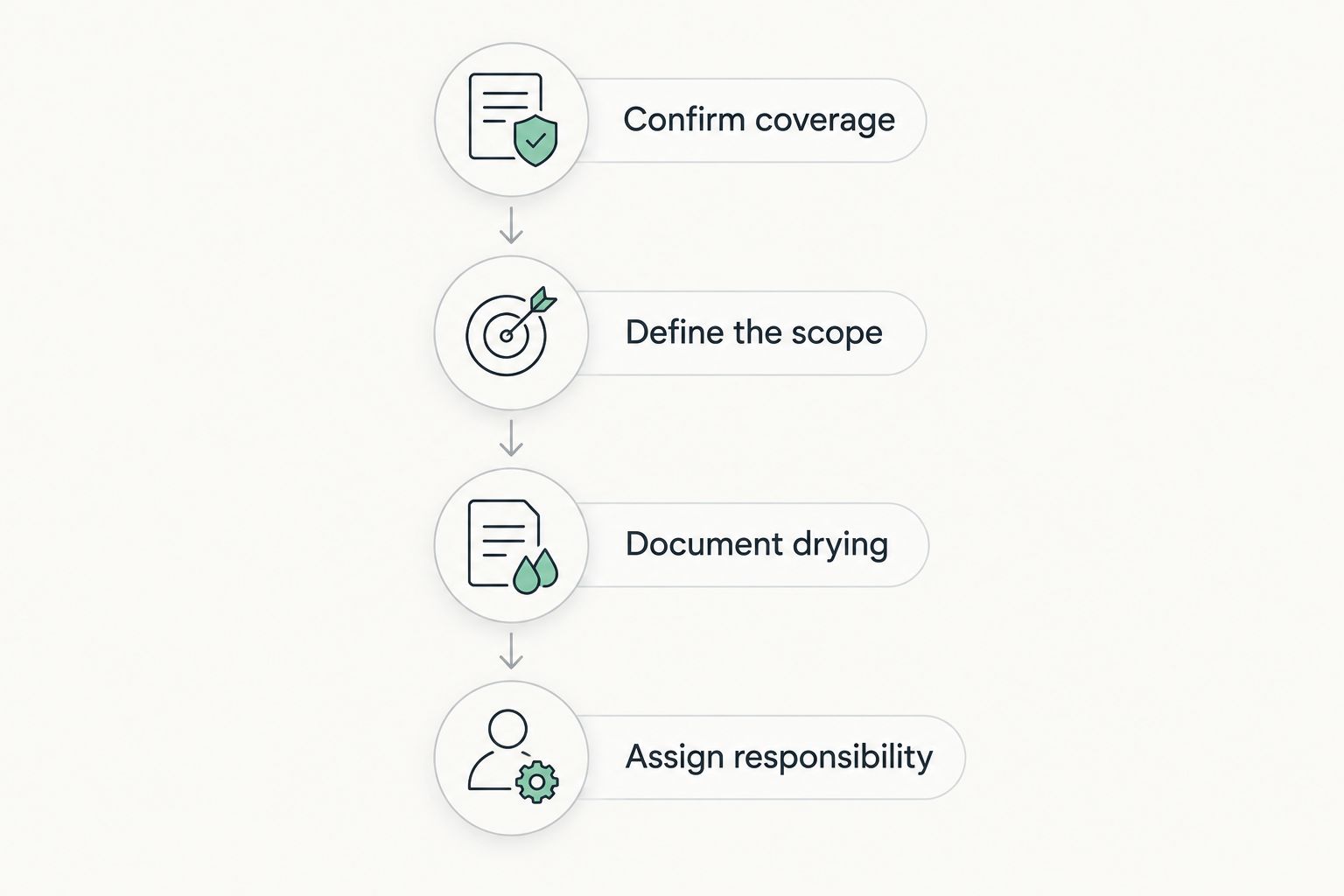
Use this sequence during the initial call and site assessment. It keeps urgent action separate from assumptions about the rest of the project.
Confirm coverage
Give the exact address, building use, and contact responsible for access. Ask which office will respond and whether it accepts the commercial assignment you have described. Confirm the anticipated arrival directly; an emergency-service description is not a dispatch commitment.
Define the scope
Explain the water source if known, the spaces affected, and any sewage or other contamination concerns. Ask which materials require assessment and who handles source repair. Do not enter standing water where electrical hazards are possible.
Document drying
Request initial moisture readings, affected-area records, and ongoing drying documentation. Ask how the contractor determines when materials are dry enough for the next phase. Equipment removal alone is not a useful completion record.
Assign responsibility
Name the person authorized to approve additional work. Establish who communicates with occupants, who controls access, and who manages any handoff to repair contractors. Keep those responsibilities visible in the agreement.
For a 2026 water-loss plan, include the EPA's moisture-control guidance: dry water-damaged areas and items within 24–48 hours to help prevent mold growth. This is a prevention window, not a promise that every commercial building can be fully restored within that period. Contamination and material conditions require assessment.
Confirm emergency cleanup coverage
Discuss your property address and cleanup needs before authorizing work.
Which commercial restoration company should you choose?
Start with the company whose stated territory and service model match your property, then require a written commercial scope. For North County emergency cleanup, start with the local option identified above. For complex recovery, include BELFOR Property Restoration; for franchise-based service, compare the responding SERVPRO and ServiceMaster Restore offices.
Do not delay safe emergency mitigation just to collect interchangeable proposals. Instead, separate the immediate authorized work from later repair decisions. Ask what needs action now, what requires further assessment, and what remains outside the contractor's responsibility.
Your 2026 selection should produce a named project contact, an understandable scope, and a drying record. Those are practical decision criteria that remain useful after the initial emergency call.
FAQ
What's the best commercial water damage restoration company in San Diego?
The best choice is the responding team that confirms your address, commercial scope, and documentation requirements. Firewaterdamage is a North County starting point; SERVPRO, BELFOR Property Restoration, and ServiceMaster Restore offer other service models to assess.
Does 24/7 emergency response guarantee an immediate arrival?
No. Emergency response availability does not establish an arrival time. Confirm dispatch, the responding office, and the proposed crew directly.
Is SERVPRO better than ServiceMaster Restore for commercial water damage?
Compare the responding franchises rather than choosing solely by the national brand. Require the same property-specific scope, project responsibilities, and drying documentation from both.
When should I include BELFOR Property Restoration on my shortlist?
Include BELFOR Property Restoration when your commercial loss involves complex recovery requirements. Describe affected systems, contents, occupancy restrictions, and repair coordination so the proposed scope addresses them.
How quickly should water-damaged materials be dried?
EPA guidance recommends drying water-damaged areas and items within 24–48 hours to help prevent mold growth. That guidance is not a guaranteed full-restoration timeline, and contaminated materials require separate assessment.
Does an IICRC credential prove a contractor can handle my whole building?
No. Relevant credentials help assess cleanup qualifications, but you must separately confirm staffing, equipment, commercial scope, and project management.
What should a commercial drying record include?
Request initial moisture readings, affected-area documentation, ongoing readings, and the basis for declaring drying complete. Ask the contractor to explain how those records support the repair handoff.
Will my property insurance cover commercial water damage restoration?
Coverage depends on your policy and the circumstances of the loss. Contact your insurer, document the damage when safe, and keep contractor authorizations and work records.
One last thing
The final moisture record matters as much as the first extraction. Before closing the cleanup assignment, obtain the completion documentation and a clear description of any unresolved damage. A dry-looking surface is not a substitute for a documented assessment of the affected materials.