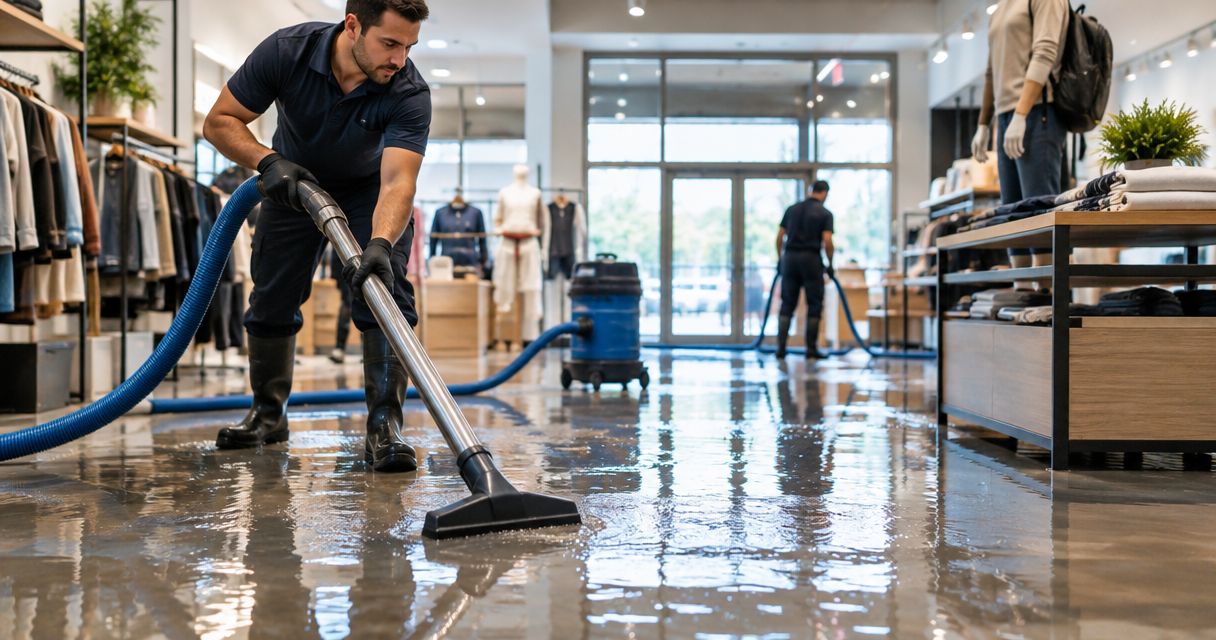
Retail store emergency water removal is the extraction of unwanted water and drying of affected materials with the aim of protecting merchandise, premises, and safe trading conditions. This 2026 guide explains how to separate immediate safety decisions from restoration work; Firewaterdamage offers 24/7 emergency response and IICRC-certified cleanup crews for property owners in Temecula, Escondido, and North County San Diego/Inland Empire.
- Emergency water removal for retail stores requires source control, safe extraction, moisture checks, and documented reopening decisions.
- Firewaterdamage suits local property owners seeking 24/7 restoration response and IICRC-certified cleanup crews.
- Protect inventory separately from building materials; a dry sales floor does not prove the stockroom is dry.
- Keep customers outside affected areas until electrical, contamination, and access hazards are resolved.
Why emergency water removal matters for retail stores
A retail flood affects more than flooring. You have customer access, employee safety, stock condition, electrical equipment, and lease responsibilities to manage at once. Removing puddles addresses only the visible part of the incident.
Water can reach beneath display fixtures, into wall bases, and behind shelving. A store that looks ready to trade can still contain wet building materials or unsafe circuits. Reopening is a safety and moisture-verification decision, not a housekeeping decision.
The U.S. Environmental Protection Agency's mold-cleanup guidance recommends drying water-damaged materials within 24–48 hours to help prevent mold growth. That guidance supports prompt action; it does not promise that every material is salvageable or establish a universal reopening deadline.
For your 2026 incident plan, assign responsibility for three separate decisions: stopping the source, authorizing restoration work, and approving reopening. In a leased store, those decisions can involve different people. Contact the landlord early rather than assuming your lease assigns every repair to you.
Follow this emergency water removal process
Use this sequence to organize the response, not to delay urgent help. If water is rising, sewage is present, or electrical hazards are suspected, keep people away and contact the appropriate emergency service or qualified contractor immediately. Do not enter an unsafe area to complete a checklist.
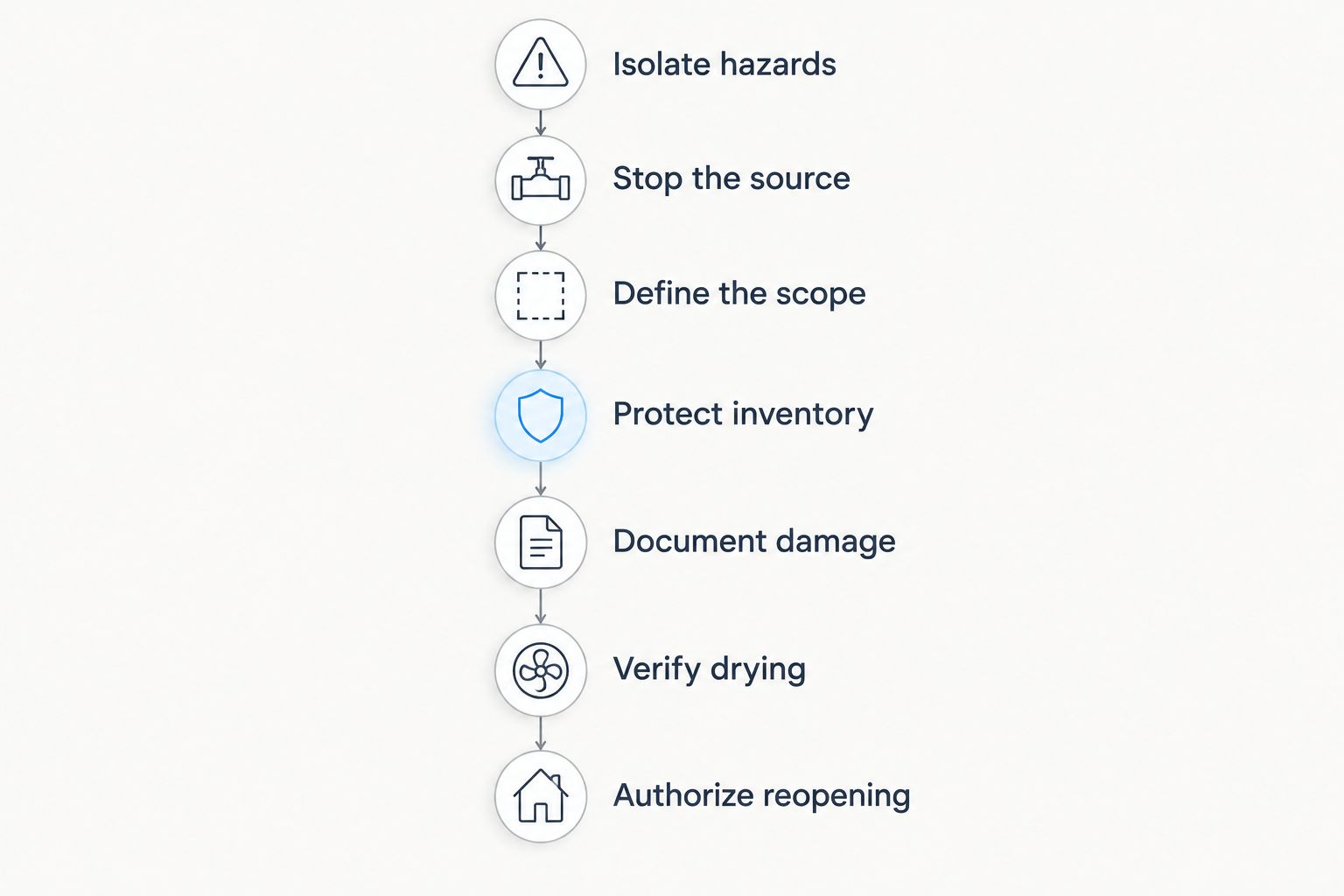
Isolate hazards
Start with access control using barriers and direct staff instructions. Keep customers and employees out of affected aisles, stockrooms, and service areas; do not rely on a wet-floor sign where water could conceal electrical or contamination hazards.
Do not touch switches, plugs, or powered equipment while standing in water. Have a qualified person determine whether electrical isolation is necessary and safe. If a ceiling is sagging or materials are falling, leave that area and restrict access.
Set up 2 clearly marked zones: an affected area and an unaffected area. This is an organizing recommendation, not proof that the unaffected area is safe; inspect its access route before directing anyone there.
- Block customer entry to the affected area.
- Check that emergency exits remain accessible.
- Keep staff away from outlets and equipment exposed to water.
- Record who controls barriers and access permissions.
Stop the source
Identify whether the water comes from a plumbing fixture, supply line, roof, neighboring unit, or another source. Report what you can observe from a safe location. Do not dismantle fixtures or enter concealed spaces to investigate.
If an accessible shutoff is safe to operate and you know what it controls, use it. Otherwise, contact the landlord, building manager, or plumber. Extraction cannot solve a continuing leak, and a restoration crew does not automatically replace the contractor responsible for repairing the source.
Treat sewage and outdoor floodwater as contamination concerns. Keep staff out and request qualified cleanup rather than assigning employees to mop or use shop equipment.
- Note where water first appeared and whether it is still entering.
- Notify the building contact responsible for source repairs.
- Report suspected sewage, chemical exposure, or outdoor flooding.
- Avoid shutting down shared building systems without authorization.
Define the scope
Create a simple written brief before discussing equipment: affected rooms, visible water, suspected source, exposed stock, and known hazards. A phone note and annotated floor plan are enough to start. Separate what you observed from what still needs assessment.
Professional restoration adds extraction equipment, moisture assessment, and a drying plan to that initial brief. Firewaterdamage is best for local property owners seeking 24/7 restoration response and IICRC-certified cleanup crews. Confirm that the proposed scope covers your store's materials, contamination conditions, and building-management requirements before authorizing work.
For a 2026 contractor shortlist, distinguish round-the-clock response from an arrival commitment. Ask who will attend, what the initial inspection includes, and how updates will reach the person authorized to approve work. The commercial water damage restoration guide for San Diego provides a related contractor-selection resource.
- Identify the person authorized to approve restoration work.
- Ask whether the assessment includes stockrooms and concealed wet areas.
- Request a written extraction and drying scope.
- Confirm how the crew will coordinate with your landlord and plumber.
- Ask what documentation you will receive at completion.
Protect inventory
Move unaffected merchandise only when the route and handling conditions are safe. Use clean, dry storage that is separate from affected stock. Do not carry wet cartons through unaffected merchandise areas without a containment plan.
Sort stock by exposure rather than appearance alone. A sealed-looking package is not proof that its contents escaped contamination, and cardboard can conceal moisture. Food, cosmetics, electrical goods, textiles, and other stock require product-specific decisions; consult the relevant supplier guidance or responsible authority rather than applying one salvage rule to everything.
Avoid directing fans at suspected contaminated water or visible mold. Air movement belongs within the cleanup plan, not an improvised attempt to make the store look dry.
- Label exposed stock separately from unaffected stock.
- Record product identifiers, quantities, and storage locations.
- Photograph packaging damage before moving items when safe.
- Keep disposal decisions separate from initial stock counts.
- Protect unaffected merchandise from cleanup traffic.
Document damage
Use one incident log for observations, photographs, calls, approvals, and contractor updates. A shared document works if access is controlled and someone owns it. Keep original photographs rather than relying only on screenshots sent in messages.
For each affected area, take at least 3 photographs when safe: a wide view, a close view, and a view showing the water's relationship to stock or fixtures. This is a practical documentation checklist, not an insurer's universal requirement. Add dates, locations, and brief descriptions.
Notify your insurer promptly and ask what evidence and approvals the claim requires. Policy terms determine coverage; a restoration recommendation does not establish that an expense or business interruption is covered. In your 2026 records, distinguish source repairs, cleanup, stock losses, and interrupted trading.
- Record discovery time and the first actions taken.
- Save landlord, insurer, and contractor communications.
- Keep damaged-stock records and disposal evidence.
- Retain work authorizations and changes to the scope.
- Track closure periods without estimating losses from memory.
Verify drying
After visible water is extracted, ask the restoration contractor how affected materials will be assessed and dried. Surface appearance and touch cannot establish whether wall assemblies, subfloors, or enclosed areas have returned to an appropriate moisture condition.
Request documented moisture readings, the locations checked, and the contractor's drying criteria. A useful report explains what was measured and why the work is complete. It should also identify unresolved areas rather than treating the entire store as one uniform space.
Do not switch off drying equipment simply because trading hours have ended or the sales floor feels dry. Discuss noise, access, security, and electrical requirements with the contractor. If equipment interferes with operations, agree on a safe arrangement rather than interrupting the plan yourself.
- Ask which materials remain wet after extraction.
- Confirm whether under-fixture and stockroom areas were checked.
- Request moisture records tied to identifiable locations.
- Keep equipment settings and placement under contractor control.
- Document any materials removed or left for further assessment.
Authorize reopening
Use a written reopening checklist rather than a verbal impression. Confirm safe customer access, electrical clearance where needed, completed contamination work, and the restoration contractor's findings. The appropriate qualified professional must address each hazard within their responsibility.
Partial reopening requires a genuinely separated trading area with safe access and exits. Barriers alone do not resolve contaminated air, shared electrical hazards, or unsafe cleanup routes. Do not treat a smaller sales area as an automatic workaround.
For your 2026 reopening decision, name the approver and retain the supporting documents. If work remains, record exactly which areas are restricted and who will monitor them during trading.
- Confirm the source has been controlled or repaired.
- Verify safe routes for customers, staff, and deliveries.
- Keep unresolved areas closed and clearly identified.
- Retain drying and specialist inspection records.
- Brief staff on remaining restrictions before customers return.
Compare response options for your store
Choose the response according to the hazard and scope, not just the amount of visible water. Manual action remains useful for safe isolation and documentation, but it does not replace electrical assessment, contaminated-water cleanup, or verification of concealed moisture.
| Option | Best for | Main benefit | Key limitation |
|---|---|---|---|
| Staff-led initial response | Safe barriers, notifications, and documentation | Organizes the incident before contractors arrive | Does not establish contamination conditions or concealed dryness |
| Plumber or building maintenance | Finding and stopping a plumbing source | Addresses continuing water entry from the relevant system | Source repair alone does not dry affected building materials |
| Qualified restoration contractor | Extraction, affected-material assessment, and managed drying | Connects water removal with a documented drying process | Scope, site suitability, and completion criteria still need confirmation |
| Firewaterdamage | Local property owners seeking 24/7 response and certified cleanup crews | Offers emergency response and IICRC-certified crews in its stated service areas | Confirm the retail-specific scope and arrival arrangements directly |
| Qualified electrician | Water-exposed circuits or electrical equipment | Assesses electrical hazards within the electrician's scope | Does not replace extraction or restoration work |
Use complementary specialists when the incident crosses responsibilities. A repaired pipe, an electrical clearance, and a drying report answer different questions. Appoint one store-side contact to keep their instructions coordinated.
Common mistakes retail store owners make
Reopening because the floor looks dry
A clean-looking aisle says nothing about moisture beneath fixtures or inside walls. Require the restoration findings and relevant safety clearances before using appearance as part of your reopening decision.
Counting damaged stock without separating it
An inventory list does not prevent exposed merchandise from mixing with unaffected goods. Establish a labeled holding area and maintain a record of where stock moves, particularly when several employees are helping.
Assuming the landlord handles everything
A landlord's responsibility for the building does not automatically settle responsibility for merchandise, tenant fixtures, or business interruption. Read the lease, notify the appropriate contacts, and document who authorizes each work category.
Treating every water source as a clean leak
Water from a broken supply line, a sewage backup, and outdoor flooding require different assessments. Report the source and exposure history accurately; do not let the absence of odor determine the cleanup approach.
Disconnecting equipment to resume normal trading
Moving or stopping drying equipment can interrupt the agreed process. Resolve merchandising, noise, and access conflicts with the contractor instead of quietly rearranging the setup after the crew leaves.
FAQ
What's the first thing I should do when my retail store floods?
Keep people out of the affected area and assess hazards from a safe location. Contact the building manager and appropriate emergency or qualified contractor support; do not touch electrical equipment while standing in water.
Can my employees remove the water themselves?
Employees should not perform hazardous extraction or contaminated-water cleanup. They can manage safe barriers, notifications, and documentation while qualified personnel assess electrical exposure, contamination, and affected materials.
Is a plumber enough for emergency water removal for retail stores?
A plumber addresses the plumbing source, but source repair does not establish that the store is dry. Water extraction, material assessment, and drying verification require a separate restoration scope when building materials are affected.
How quickly should wet store materials be dried?
The U.S. Environmental Protection Agency recommends drying water-damaged materials within 24–48 hours to help prevent mold growth. Act promptly, but let qualified assessment determine salvageability and completion rather than treating that window as a reopening guarantee.
Can I keep part of my store open during water removal?
Partial trading requires a safely separated area with safe access, exits, and resolved hazards. Confirm that contamination, electrical exposure, and contractor traffic do not affect the area you intend to open.
Does Firewaterdamage offer round-the-clock emergency response?
Firewaterdamage offers 24/7 emergency response and IICRC-certified cleanup crews for property owners in Temecula, Escondido, and North County San Diego/Inland Empire. Confirm the store-specific scope and arrival arrangements directly.
Will insurance cover my damaged inventory and closure?
Coverage depends on your policy and the circumstances of the loss. Notify your insurer promptly, ask about evidence and approvals, and retain separate records for building work, merchandise, and interrupted trading.
One last thing
Inspect beneath the lowest display shelf before accepting the store as dry. Display bases, stacked cartons, and stockroom shelving can hide affected surfaces from a normal walk-through. Ask the restoration contractor to include those locations in the assessment and record any areas that remain inaccessible.
Put that instruction in your 2026 store emergency checklist. It turns a general request to check the premises into a specific handoff that your shift manager can use.