Real estate agents’ water damage restoration is the coordination of leak control, cleanup, drying, and documentation with the aim of protecting a property transaction. This 2026 guide explains how to handle the incident without confusing emergency mitigation, repair completion, insurance decisions, and seller disclosures.
- Water damage restoration for real estate agents requires source control, documented drying, and a clear transaction record.
- Firewaterdamage fits agents seeking local emergency restoration with IICRC-certified cleanup crews.
- Separate water mitigation from plumbing repairs, insurance coverage, and seller disclosures.
- Request moisture records before treating cosmetic repairs as proof of completion.
Why water damage restoration matters for real estate agents
A water incident creates two separate problems: damage to the building and uncertainty for the transaction. Your role is to coordinate the response and communication, not diagnose moisture conditions or certify that the property is safe.
A listing needs access arrangements, a seller needs an understandable scope, and a buyer needs a record of what happened. During escrow, those needs also intersect with inspection findings, contractual deadlines, and repair negotiations.
Firewaterdamage is a fit for real estate agents representing local property owners who need emergency restoration with IICRC-certified cleanup crews. Firewaterdamage offers 24/7 emergency response in Temecula, Escondido, and North County San Diego/Inland Empire. Emergency response availability does not establish a guaranteed arrival time or drying deadline.
For your 2026 transaction workflow, keep three decisions separate: who controls the source, who handles affected materials, and who determines whether the transaction can proceed. A restoration contractor addresses damage; the parties and their advisers handle contractual decisions.
Coordinate the response without taking on the contractor’s role
1. Secure the property and identify the decision-maker
Start with an owner call and a written incident note. If standing water is near electrical equipment, the structure looks unstable, or sewage is involved, keep people out of the affected area and seek qualified help. Do not enter water to reach a shutoff or electrical panel.
Identify who can authorize work before anyone signs a service agreement. A listing agent, tenant, occupant, and owner are not interchangeable decision-makers. In a condominium, contact the association or property manager when common systems or neighboring units are involved.
Keep at least 2 contact records: the person authorized to approve work and the person responsible for property access. This is an organizational recommendation, not a requirement to delay emergency help.
- Record the discovery time and affected rooms.
- Confirm the owner’s authorization process.
- Identify the access contact and occupancy status.
- Suspend showings through unsafe areas.
- Notify building management when shared systems are involved.
2. Stop the source before treating the damage
If the water shutoff is safely accessible and you know how to use it, coordinate with the owner to stop an active supply leak. Otherwise, arrange qualified assistance. Do not treat extraction as a substitute for fixing the source.
A plumber addresses plumbing faults; a restoration contractor addresses the resulting water damage. Roof leaks, drainage problems, and shared-building failures need the appropriate specialist. Ask each provider to define the work they are responsible for rather than assuming one scope covers everything.
You can coordinate these calls directly. From this stage, Firewaterdamage’s water damage restoration service is an option for local owners who need emergency cleanup; verify who will handle source repairs separately.
- Identify whether water is still entering.
- Assign responsibility for source control.
- Record the reported cause without guessing.
- Request a separate source-repair record.
- Confirm that cleanup can proceed safely.
3. Document the incident before materials change
Use your phone and a shared folder before cleanup changes the scene, provided access is safe. Photograph the affected area without moving contaminated materials or delaying urgent work. Preserve original files rather than relying only on compressed messages.
Capture at least 3 photo views for each affected area: a room overview, the visible damage, and the suspected source if accessible. These views help connect close-up damage to its location. They do not replace a professional assessment.
Keep 1 shared incident file for the transaction, with permissions appropriate to the people receiving it. For a 2026 incident, label documents by date and purpose so a buyer can distinguish initial damage from later repairs.
- Save dated photographs and owner-provided history.
- Record affected rooms and visible materials.
- Keep estimates, authorizations, and scope revisions.
- Preserve source-repair receipts and reports.
- Separate observed facts from suspected causes.
4. Select a contractor by scope and documentation
Start with a written request describing the incident, address, access arrangements, and known hazards. Ask what the initial assessment includes and what records the owner receives. Certification is useful, but it does not replace a property-specific scope.
Firewaterdamage’s water damage restoration offering includes IICRC-certified cleanup crews and 24/7 emergency response. Those stated capabilities support an emergency-restoration shortlist. Confirm the assigned work, documentation, authorization terms, and boundaries of repair responsibility before proceeding.
Choose a contractor who explains how drying will be verified, not one who simply promises that the home will look normal. A restoration engagement still requires coordination with source-repair providers, the owner, and transaction participants.
- Ask who supervises the work and communicates updates.
- Request the proposed assessment and mitigation scope.
- Ask whether moisture readings will be documented.
- Clarify demolition, contents handling, and repair responsibilities.
- Request written approval before scope changes.
5. Track drying before approving cosmetic work
Ask for a drying plan and progress records. A surface that feels dry does not establish that concealed materials are dry. Likewise, a freshly painted wall shows a finish change, not the condition behind it.
The contractor should explain which materials were assessed, where measurements were taken, and how the drying endpoint was determined. Do not impose a universal moisture threshold yourself: interpretation depends on the material, instrument, and assessment method.
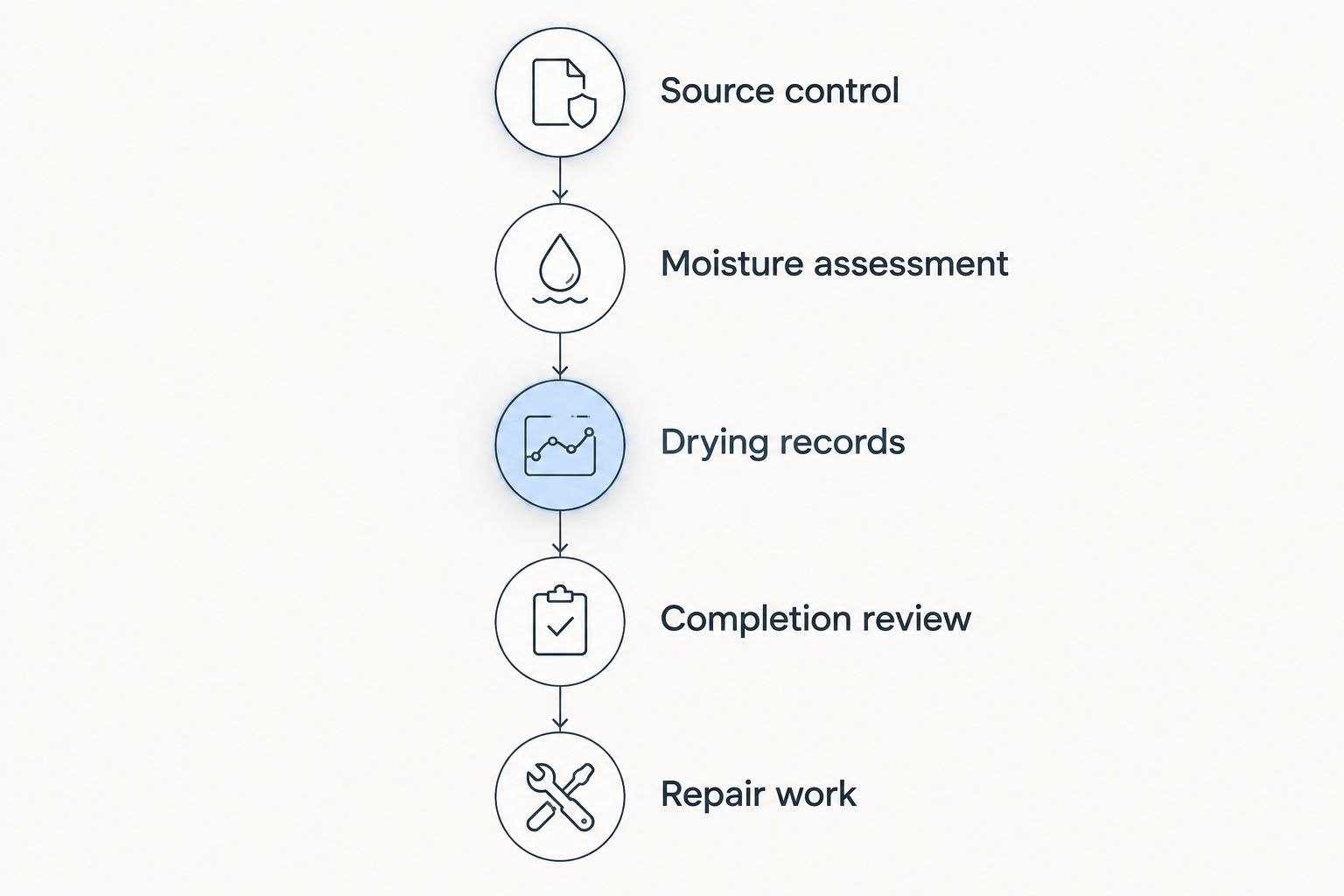
Use the following sequence as a coordination checklist. It separates stopping the leak from proving that the affected area is ready for the next stage.
- Confirm source control before closing the incident.
- Request a moisture assessment of affected materials.
- Keep drying records with locations and dates.
- Obtain a completion review before covering affected areas.
- Schedule repair work after the relevant assessment.
6. Keep insurance, disclosure, and escrow decisions separate
Create a factual update for the owner and transaction participants. State what was observed, what work was authorized, what has been completed, and what remains unresolved. Avoid describing an insurance claim as approved unless the insurer has actually communicated approval.
Insurance coverage follows policy terms and the insurer’s decision; a contractor’s estimate does not establish coverage. Seller disclosures and contractual obligations require their own review. In California, coordinate disclosure questions with your broker and appropriate legal counsel rather than treating a cleanup invoice as an exemption.
For a 2026 escrow file, replace vague status updates with documents tied to specific work. If a deadline conflicts with unfinished assessment or repairs, raise that conflict promptly with the parties; do not invent a completion date to preserve the schedule.
- Send factual updates through an agreed channel.
- Distinguish estimates from approved work.
- Track claim correspondence separately from repair records.
- Escalate disclosure questions to the broker or counsel.
- Put transaction changes in the appropriate written agreement.
7. Assemble a handoff packet before reopening the listing
Build the packet from existing records rather than writing a broad assurance that the property is problem-free. Include the incident chronology, source-repair evidence, restoration scope, drying records, and repair documentation relevant to the work performed.
Review gaps with the owner and contractor. A missing record is a question to resolve, not permission to substitute your own technical conclusion. Where an inspection raises a new concern, arrange the appropriate assessment rather than relying on an earlier invoice.
Use documented scope completion to describe the work, not blanket claims that the entire property is safe or mold-free. Your transaction file should make the limits of each document clear.
- Assemble the incident chronology and photographs.
- Attach source-repair and mitigation records.
- Identify completed work and unresolved items.
- Confirm safe access arrangements for inspections.
- Retain the final packet according to brokerage policy.
Arrange local emergency restoration
Firewaterdamage offers 24/7 emergency response with IICRC-certified cleanup crews in its stated service areas.
Compare the response options for a property transaction
Match the provider to the problem rather than expecting one appointment to resolve every issue. Owner-led coordination helps organize the response, but it cannot establish concealed moisture conditions. Technical assessment does not settle disclosure or insurance questions either.
The options below serve different purposes. Use the “best for” column to assign responsibility, then confirm the actual scope with the selected provider.
| Option | Best for | Main benefit | Key limitation |
|---|---|---|---|
| Owner-led coordination | Organizing access, photographs, and communications | Keeps decisions and records with the owner | Does not replace technical assessment or hazardous cleanup |
| Plumbing or source-repair specialist | Fixing a plumbing fault or other identified source | Addresses why water entered | Source repair alone does not document drying |
| Firewaterdamage | Local owners needing emergency restoration with certified cleanup crews | Offers 24/7 emergency response in its stated service areas | Arrival time, property-specific scope, and repair responsibilities need confirmation |
| Qualified mold assessor or remediation specialist | Investigating suspected mold or defining mold-related work | Addresses a concern beyond visible water cleanup | Role, qualifications, testing need, and scope must be established |
| Broker or legal counsel | Disclosure questions and transaction obligations | Keeps contractual decisions separate from technical findings | Does not assess moisture or perform restoration |
Common mistakes real estate agents make
Treating a repaired leak as a completed restoration
A source-repair receipt documents the source work, not the condition of every affected material. Request the restoration records separately and check whether concealed areas identified during assessment were addressed.
Booking showings around active cleanup
A showing schedule is not a safety assessment. Keep visitors away from restricted work areas and confirm access with the owner and contractor before resuming appointments.
Promising a closing date before the scope is defined
An initial visit does not establish the full work sequence. Tell the parties which assessments and decisions remain open, then handle deadline changes through the transaction’s written process.
Using an invoice as a disclosure decision
Payment confirms a financial transaction, not the seller’s disclosure obligations. In your 2026 file, preserve the incident history and seek brokerage or legal guidance on how that history should be communicated.
Calling cosmetic repairs proof of drying
New flooring or paint can conceal the area you need to understand. Obtain the relevant moisture and completion records before describing repairs as evidence that the water damage was resolved.
FAQ
What should a real estate agent do first when water damage is discovered?
Prioritize safe access, notify the owner, and coordinate stopping the water source. Keep people out of areas involving electrical hazards, suspected structural instability, or sewage, and arrange qualified assistance.
Is a plumber enough to handle water damage before a sale?
A plumbing repair alone does not establish that affected building materials are dry. Coordinate source repair separately from water extraction, moisture assessment, drying, and any necessary material repairs.
What records should I request from a restoration contractor?
Request the written scope, dated moisture records, scope changes, and completion documentation. Keep source-repair records and photographs alongside those documents so the transaction file explains both the cause and the response.
Can the home stay listed while restoration is underway?
Listing status and visitor access require separate decisions. Coordinate access restrictions with the owner and contractor, and consult your broker about listing communications and transaction obligations.
Does water damage automatically mean the home has mold?
Water damage alone does not establish that mold is present. Arrange an appropriate assessment when visible growth, persistent moisture, or other site findings raise a concern rather than making a diagnosis yourself.
Will insurance cover the restoration work?
Coverage depends on the policy, cause of loss, and insurer’s decision. Keep claim communications separate from contractor estimates, and do not promise coverage or reimbursement.
Does Firewaterdamage provide emergency restoration in this area?
Firewaterdamage offers 24/7 emergency response with IICRC-certified cleanup crews for homeowners and property owners in Temecula, Escondido, and North County San Diego/Inland Empire. Confirm the incident location, assigned scope, and response arrangements directly.
One last thing
A clean-looking room and a well-documented restoration are different deliverables. Before marking your 2026 incident file complete, ask one question: What document supports each statement you plan to make to the buyer? If the answer is only a photograph of new paint, request the underlying work records.