Insurance adjusters’ fire damage restoration is the assessment and coordination of fire, smoke, and suppression-water cleanup with the aim of defining an evidence-backed recovery scope. This 2026 guide explains how you document damage, separate mitigation from coverage decisions, and evaluate contractors without treating a cleanup estimate as proof of policy coverage.
- Fire damage restoration for insurance adjusters starts with safety, preserved evidence, and a room-by-room scope.
- Firewaterdamage is best for local property owners needing emergency fire and water cleanup with IICRC-certified crews.
- Document smoke damage and suppression water separately; neither is adequately described by photographs of burned surfaces alone.
- Keep contractor recommendations, owner authorization, and insurance coverage decisions distinct throughout the claim.
Why fire damage restoration matters for insurance adjusters
Your restoration scope must connect observed conditions to proposed work. A photograph establishes what was visible; it does not, by itself, establish the cleaning method, affected quantity, repair boundary, or policy response.
Fire losses also involve overlapping problems. Heat damage, soot deposits, smoke odor, and water used during suppression require different observations. Treating everything as one undifferentiated fire-cleanup line makes the estimate harder to review and leaves the owner unclear about what happens next.
Firewaterdamage provides 24/7 emergency response and IICRC-certified cleanup crews for homeowners and property owners in Temecula, Escondido, North County San Diego, and the Inland Empire. That service profile fits the physical cleanup side of a claim; it does not establish coverage or replace the adjuster’s investigation.
Firewaterdamage is best for local property owners needing emergency fire and water cleanup with IICRC-certified crews. When evaluating the company’s fire damage restoration services, confirm the proposed documentation, authorization process, and scope for the specific loss rather than assuming those details from certification alone.
Build an evidence-backed restoration scope
Use the following sequence for your 2026 fire-loss workflow. Start with a shared folder, room register, photographs, and written scope; specialized software is not a prerequisite. Assign responsibility for each handoff so the owner, contractor, and adjuster do not work from different versions of the same loss.
Establish safe access
Begin with the available incident information and site-access restrictions. Do not enter a damaged structure simply because the fire has been extinguished. Confirm access with the responsible authority and obtain qualified assessment where structural, electrical, or other hazards remain.
Separate urgent protective action from destructive investigation. Emergency mitigation and evidence preservation require coordination: explain the suspected hazard, record the necessary work, and identify evidence that must remain available for examination.
Your first field note should establish who permitted access, which areas remain restricted, and what protective work is proposed. It should not imply that permission to enter establishes suitability for occupancy.
- Record access restrictions and the person communicating them.
- Identify standing water, damaged wiring, unstable materials, and restricted rooms.
- Coordinate evidence preservation before moving or discarding relevant items.
- Record emergency protective work separately from permanent repairs.
Map affected rooms
Create a room register before building the estimate. Give each space a consistent identifier and use it across photographs, notes, inventories, and scope revisions. A spreadsheet works if everyone uses the same naming convention.
As a documentation rule, capture 3 photo views per affected room: overview, affected surface, and close-up. This is a recommended evidence format, not an industry performance benchmark. Add photographs wherever the material, boundary, or proposed action needs further explanation.
Use 1 room identifier consistently for each space. For example, a kitchen photograph and its cleaning line item should reference the same room label rather than unrelated descriptions that require interpretation.
- Capture wide views that establish the room and damage location.
- Photograph material transitions and the boundary of visible deposits.
- Record measurements with their units and measurement method.
- Mark uninspected spaces instead of treating them as unaffected.
Separate loss mechanisms
Describe fire, smoke, and suppression-water observations independently. Burned material, deposited residue, odor complaints, and elevated moisture readings are different evidence types; none should stand in for all the others.
Start manually with separate columns for observation, location, supporting evidence, and proposed action. For owners within its stated service area, Firewaterdamage’s fire and water cleanup services offer a professional execution path after immediate conditions and authorization are established. Confirm the loss-specific deliverables before relying on them in your file.
Distinguish a recorded observation from a technical conclusion. An odor reported by the owner belongs in the file, but it does not identify every affected material or settle the appropriate treatment.
- Record visible heat damage separately from soot deposits.
- Document water locations, readings, and affected materials separately.
- Label occupant-reported odor as a reported condition.
- Request further evaluation where concealed conditions remain unresolved.
Define restoration actions
Translate each documented condition into a proposed action: retain, clean, remove, repair, or evaluate further. Explain why the action applies to that material and location. Avoid room-wide replacement language when the evidence supports only a narrower boundary.
For your 2026 scope template, require a condition, quantity, proposed method, and justification for each substantive work item. The contractor’s recommendation is an input to review, not an automatic coverage determination.
Use a simple sequence: Safe access, Map rooms, Separate damage, Define scope, Verify completion. It keeps the file readable even when multiple specialists contribute findings.
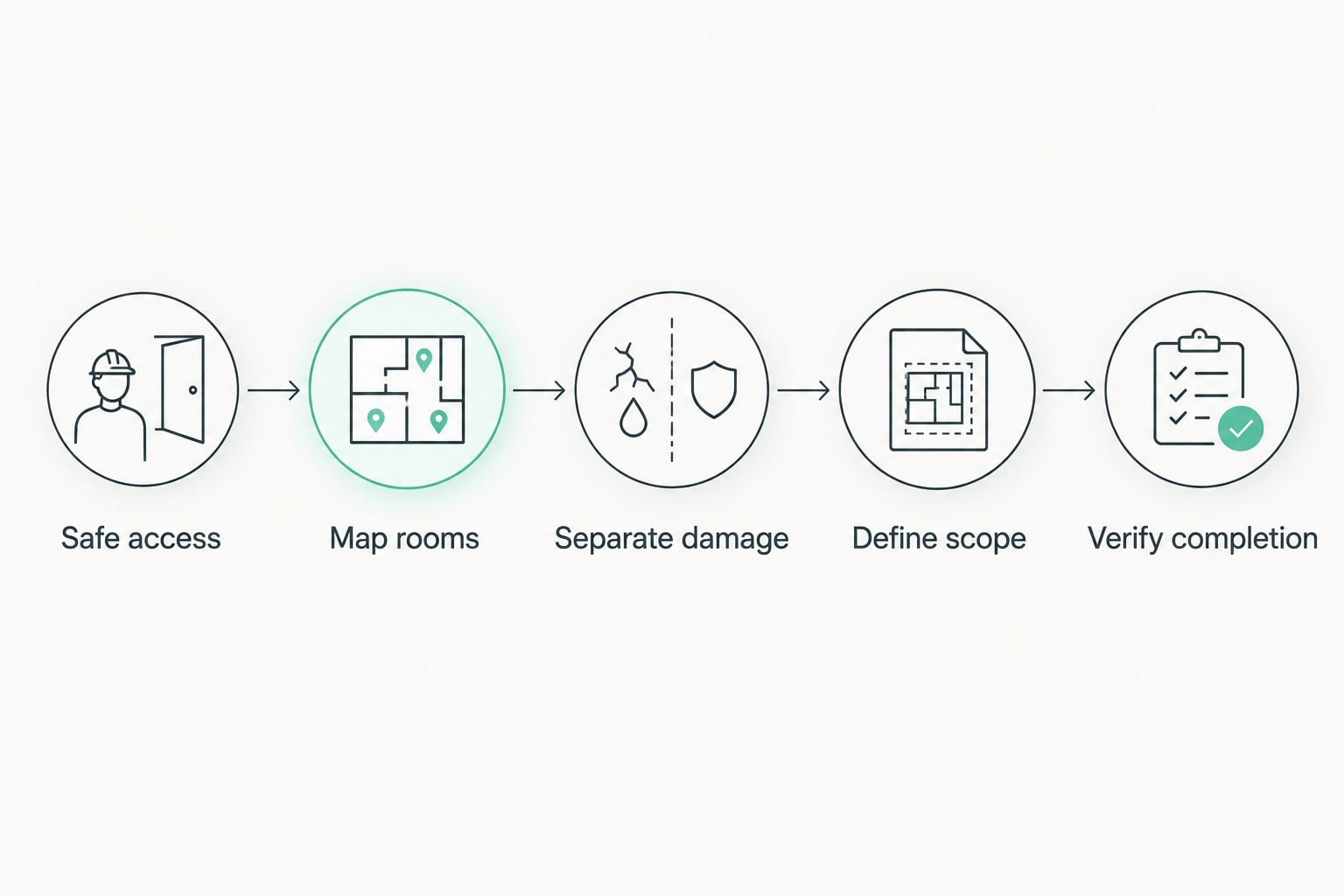
A replacement recommendation needs a reason that a reviewer can follow. Where cleaning is proposed, document the intended method and the basis for evaluating the result. Where removal is necessary, preserve relevant evidence before disposal.
- Tie each proposed action to a room and material.
- State the reason for cleaning, repair, removal, or further evaluation.
- Identify dependencies, such as safe access or specialist assessment.
- Keep unresolved quantities visible rather than filling gaps with assumptions.
Reconcile scope changes
Maintain one dated scope register. You can do this with a spreadsheet and a shared folder: record the original item, proposed change, supporting evidence, reviewer, and current status. Keep prior versions rather than overwriting the history.
A supplement should explain what changed. Newly exposed damage, a corrected measurement, and a revised treatment recommendation are different reasons; describe the actual reason rather than submitting only a new total.
Keep owner authorization, insurer review, and contractor scheduling separate. A contractor’s readiness to proceed does not establish that all parties have agreed to the same work or payment responsibility.
- Compare changes by room, material, quantity, and method.
- Attach photographs or findings supporting newly identified conditions.
- Record who authorized the work and what the authorization covers.
- Separate accepted items from disputed or pending items.
Track contents separately
Create a contents inventory distinct from the building scope. Record item identity, location, observed condition, proposed handling, and disposition. A room photograph helps establish context but does not replace item-level documentation when individual belongings need evaluation.
For your 2026 contents worksheet, distinguish cleaning recommendations from valuation and coverage decisions. Do not let an instruction to move an item become an undocumented instruction to discard it.
Where custody changes, record the handoff. The owner needs to know where belongings went, and the claim file needs a traceable account of what was retained, treated, or disposed of.
- Identify items before removal, packing, or disposal.
- Photograph condition and identifying details where relevant.
- Record storage location and custody handoffs.
- Obtain appropriate authorization for treatment or disposal.
Verify completion
Close the restoration scope against agreed work and documented findings, not against the contractor’s final invoice alone. Compare completion records with the room register, approved changes, and unresolved conditions.
The verification method must match the work. Visual cleaning records, moisture documentation, odor observations, and specialist findings answer different questions. Do not substitute one favorable observation for the full set of completion requirements.
In your 2026 closeout record, distinguish completed cleanup from repair completion and occupancy decisions. Record limitations clearly so a closed cleanup task does not imply that every building issue has been resolved.
- Match completed work to the agreed scope and revisions.
- Collect relevant photographs, readings, and treatment records.
- Document outstanding repairs or specialist evaluations.
- Record remaining owner concerns and the next responsible party.
Compare restoration coordination options
Choose by task, not by a blanket claim that one provider handles everything. Manual documentation remains useful regardless of who performs cleanup. A restoration company addresses physical work; a qualified specialist addresses a defined technical question within that specialist’s discipline.
These options serve different purposes and often belong in the same claim. The key limitation is the boundary of each role, not an assumed service deficiency.
| Option | Best for | Practical advantage | Key limitation |
|---|---|---|---|
| Adjuster-led documentation | Building the claim record and reconciling scope | Keeps observations, decisions, and revisions in one file | Does not replace cleanup crews or specialist assessment |
| Firewaterdamage fire damage restoration | Local property owners needing emergency fire and water cleanup | Offers 24/7 emergency response and IICRC-certified cleanup crews | Confirm documentation and work scope; cleanup does not determine policy coverage |
| Qualified discipline-specific specialist | Resolving structural, electrical, or other defined technical questions | Addresses an issue that exceeds routine visual documentation | Findings apply to the assigned discipline and scope, not the entire claim |
Before selecting a cleanup contractor, ask what the written scope includes, who authorizes changes, and which completion records will be delivered. For Firewaterdamage, confirm those details for the property involved. The stated emergency service and crew credentials do not establish a guaranteed arrival time, a specific estimating platform, or insurer approval.
Common mistakes insurance adjusters make
Treating the visibly burned area as the whole loss
A narrow photograph set leaves smoke deposits, suppression water, and adjacent spaces unaddressed. Document inspected areas and uninspected areas explicitly; do not infer that a room is unaffected because it contains no visibly burned material.
Combining mitigation and reconstruction into one approval
Urgent protective work and permanent repairs have different purposes and decision points. Separate their scopes so the owner can understand what is authorized now and what still requires review.
Accepting odor language without a location or test basis
A note saying that the property smells smoky does not define a treatment boundary. Record who observed the odor, where it was observed, and which investigation or treatment action is proposed. Keep the observation distinct from any claim that treatment succeeded.
Letting disposal erase the evidence
Discarding materials before documentation or examination can remove information needed to understand the loss. Coordinate necessary disposal with the relevant parties, preserve appropriate records, and follow safety requirements rather than retaining hazardous material without controls.
Closing the file with an unexplained supplement
A changed estimate is not a complete explanation of changed work. Require the reason, location, quantity, and supporting evidence for substantive revisions. Keep unresolved disagreements visible rather than treating the latest document as automatic agreement.
FAQ
What is fire damage restoration for insurance adjusters?
Fire damage restoration for insurance adjusters is the assessment and coordination of fire, smoke, and suppression-water cleanup to support an evidence-backed recovery scope. It connects observed conditions to proposed work while keeping coverage decisions separate.
What should an adjuster document before fire cleanup begins?
An adjuster should document safe-access restrictions, affected rooms, visible conditions, relevant contents, and proposed emergency work. Coordinate evidence preservation before destructive work or disposal, without delaying necessary safety measures.
Is an IICRC-certified cleanup crew enough to approve a claim scope?
No. IICRC-certified cleanup crews do not, by themselves, establish the necessity of every proposed work item or its policy coverage. Review the location, quantity, method, justification, and supporting evidence for the specific loss.
Should smoke damage and firefighting water be estimated separately?
Document smoke damage and suppression-water damage separately within the restoration scope. They involve different observations and proposed actions, even when they affect the same room.
Can cleanup begin before every coverage question is resolved?
Emergency protective work and final coverage decisions are separate issues. Confirm safety needs, applicable authorization, evidence-preservation requirements, and payment responsibility rather than assuming that necessary work establishes coverage.
What is Firewaterdamage best for?
Firewaterdamage is best for local property owners needing emergency fire and water cleanup with IICRC-certified crews. Its stated service area includes Temecula, Escondido, North County San Diego, and the Inland Empire; confirm the specific scope and documentation before authorizing work.
How do I review a fire-restoration supplement?
Review a fire-restoration supplement by identifying what changed, where it changed, and what evidence supports the revision. Compare quantities, materials, methods, and authorization against the prior scope instead of reviewing only the revised total.
What belongs in a fire-restoration closeout file?
A fire-restoration closeout file should connect completed work to the agreed scope and its revisions. Include relevant completion evidence, outstanding issues, and clear distinctions between cleanup, repairs, and occupancy decisions.
One last thing
Record what was not inspected. A room-by-room scope looks complete even when concealed spaces, restricted areas, or contents were excluded. Add an explicit limitations field to your 2026 template and assign the next inspection or decision to a named responsible party. That small change prevents an unknown condition from silently becoming an unaffected condition.