There is no fixed water depth, number of gallons, or percentage of wet rooms that makes a house a total loss. The decision depends on structural safety, contamination, the full repair scope, and the insurance policy’s valuation and settlement terms—not simply how much water entered.
- How much water damage before a house is a total loss depends on repairability and insurance terms, not water depth alone.
- A temporarily uninhabitable house is not automatically a total loss.
- Firewaterdamage provides 24/7 emergency response with IICRC-certified cleanup crews in its stated Southern California service area.
- Document structural damage, contamination, and hidden moisture before accepting a repair-or-rebuild conclusion.
Why this matters: A soaked house can look beyond repair while its structure remains repairable. The opposite also happens: relatively little visible water can conceal damage behind walls or beneath flooring.
For homeowners in Temecula, Escondido, and North County San Diego/Inland Empire, Firewaterdamage offers emergency restoration response. Emergency cleanup and a total-loss determination are different decisions: stopping further damage does not establish what an insurer owes.
How much water damage before a house is a total loss?
A house becomes a total-loss question when the documented damage raises serious concerns about safe repair or when the repair-versus-replacement assessment meets the applicable policy and legal criteria. There is no universal residential threshold you can apply from a photograph, a waterline, or the number of affected rooms.
For a 2026 claim, distinguish these three conditions before discussing demolition:
| Condition | What it means | Best next action | What it does not establish |
|---|---|---|---|
| Repairable damage | Damaged materials and systems have an identified repair scope | Stabilize the property and document the complete repair plan | That every wet material can remain |
| Temporarily uninhabitable | Current conditions make occupancy unsafe or unsuitable | Obtain a safety assessment and ask about applicable living-expense coverage | That demolition is necessary |
| Potential total loss | Repairability or the claim valuation requires a formal assessment | Request written structural findings, estimates, and policy reasoning | That the policy pays every rebuilding expense |
A total-loss label needs a documented basis, not a dramatic description of the damage. Ask whoever uses the term to identify whether they mean a structural conclusion, an insurance settlement position, or a recommendation to rebuild.
Can a deeply flooded house still be repaired?
Deep flooding does not, by itself, establish that a house must be demolished. An evaluation must address the foundation, framing, connections, affected systems, contamination, and materials that cannot be adequately cleaned or dried.
Repairability is not the same as a simple cleanup. A repairable structure can still require extensive removal of finishes, replacement of affected systems, and inspections before occupancy.
Does a shallow leak mean the house is safe?
A shallow leak does not establish safety either. Water can travel beneath flooring, enter wall cavities, or affect electrical components without leaving a high waterline.
Base the next decision on where the moisture went, not just where you can see it. The guide to signs of hidden water damage explains what deserves closer investigation.
What determines whether the house can be restored?
The assessment needs to separate damaged finishes from damaged structural components. Wet carpet and stained drywall are visible evidence; they are not a substitute for evaluating the parts that carry loads or keep electrical systems safe.
Ask for findings that identify the affected materials, their condition, and the basis for keeping or removing them. A useful report makes the repair recommendation traceable to observations rather than treating every wet surface alike.
Structural condition
Foundation movement, displaced framing, and visibly sagging ceilings require professional evaluation. Floodwater can also exert forces on a building, so removing the standing water does not resolve every structural question.
Do not enter a visibly unstable area to take better photographs. An engineer evaluates structural concerns; the insurer evaluates coverage and settlement under the policy.
Contamination and material condition
A plumbing supply leak and a sewage backup do not present the same cleanup problem. The source of the water, what it contacted, and the condition of affected materials influence cleaning and removal decisions.
Porous materials contaminated by sewage generally require removal rather than surface cleaning. That expands the repair scope, but contamination alone does not prove the entire building is a total loss.
Hidden moisture and affected systems
A dry-looking surface does not establish that the assembly behind it is dry. Request moisture findings for affected cavities and materials, along with documentation of inaccessible areas.
Electrical, heating, and other building systems need their own assessment where water exposure creates concerns. A restoration drying report does not replace the relevant trade professional’s safety evaluation.
Why total-loss decisions vary
In 2026, a meaningful repair-versus-rebuild assessment still depends on the specific house, damage, and policy. These factors explain why similar-looking incidents can lead to different outcomes:
- Water source and contamination: Sewage, floodwater, and a supply-line leak create different cleaning and removal requirements.
- Exposure duration: Continued wetting gives moisture more opportunity to spread and damage materials.
- Structural involvement: Damage to finishes requires a different response from damage affecting load-bearing components.
- Concealed conditions: Wet insulation, subfloors, and enclosed cavities can expand the scope beyond what photographs show.
- Required reconstruction: Permits, applicable code requirements, and affected building systems influence what a complete repair entails.
- Policy terms and valuation: Coverage limits, exclusions, deductibles, and settlement provisions affect the claim outcome separately from physical repairability.
Do not turn any single factor into a shortcut. Extensive finish removal is not proof of structural failure, and an intact-looking exterior is not proof of a safe interior.
What should you do before accepting a total-loss decision?
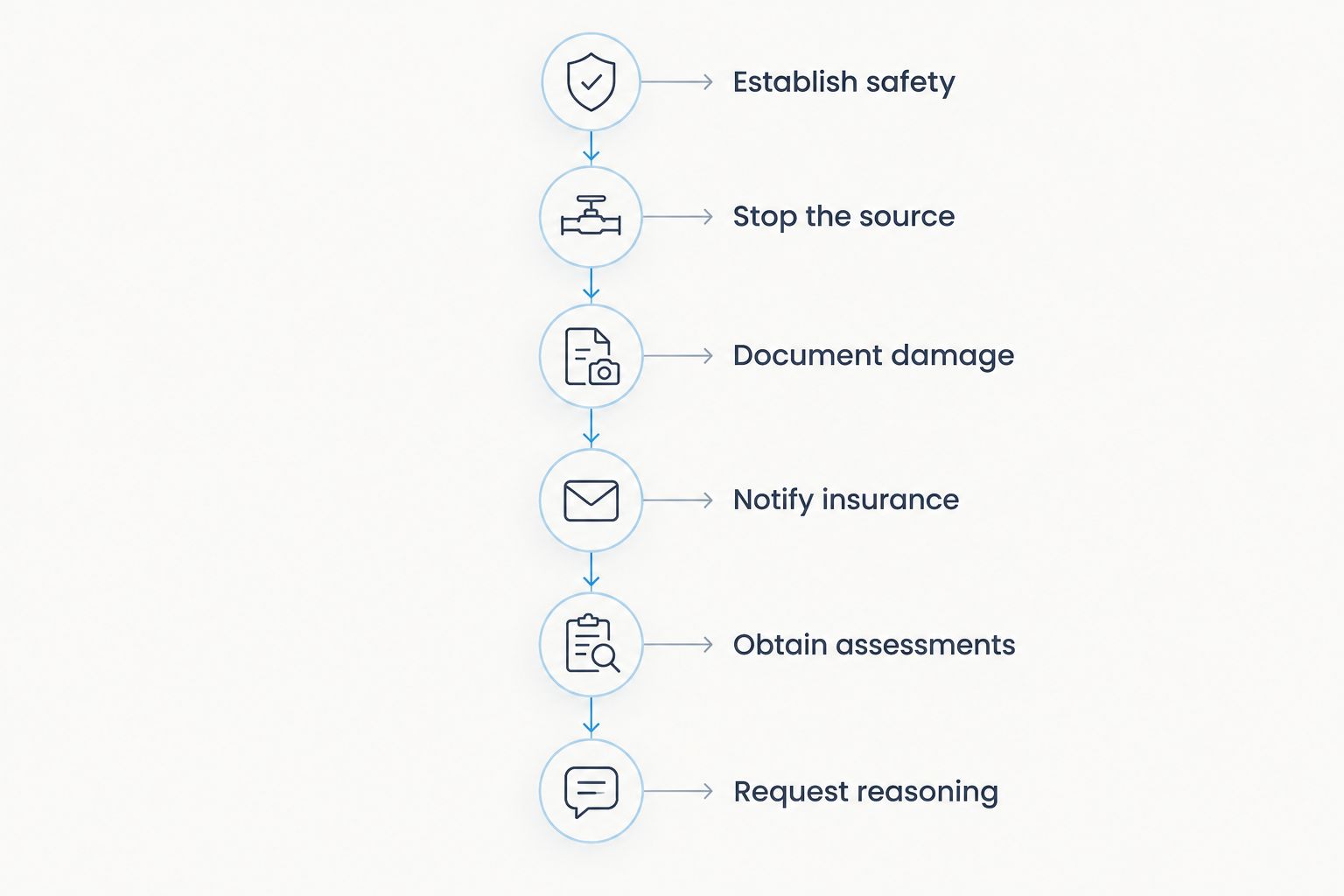
Protect people first, then preserve the evidence needed for a sound decision. You do not need a final settlement agreement before reporting an active loss or asking what emergency protective work is authorized.
- Establish safety. Stay out of standing water when electrical hazards are possible. Leave areas with sagging ceilings, movement, or suspected structural instability until qualified professionals assess them.
- Stop the source. Shut off the water only if you can reach the appropriate valve safely. Do not enter a hazardous area to operate equipment or retrieve belongings.
- Document damage. Take photographs and video from safe locations. Record the affected rooms, visible waterlines, damaged belongings, and the known sequence of events without guessing when the damage began.
- Notify insurance. Report the incident promptly and request instructions for emergency mitigation, documentation, and the claim inspection. Keep records of communications and any work authorized.
- Obtain assessments. Request the restoration scope, moisture findings, and specialist reports needed for structural or system concerns. Ask how newly discovered damage will be documented.
- Request reasoning. Before accepting a total-loss conclusion, obtain the written basis, applicable policy provisions, and explanation of how the damage assessment supports the proposed settlement.
A 2026 claim file should tell a consistent story: what happened, what was affected, what work is necessary, and which decisions remain unresolved. Keep original photographs, reports, estimates, and receipts together rather than relying on a verbal summary.
Does acting quickly prevent a total loss?
Prompt action helps limit additional damage, but it does not guarantee that a house is repairable. Existing structural damage, contamination, and the extent of water exposure still need assessment.
The U.S. Environmental Protection Agency’s household mold guidance recommends drying wet materials within 24–48 hours to help prevent mold growth. This is a prevention guideline, not a deadline after which a house automatically becomes a total loss.
At 24 hours, do not assume that materials are safe merely because they remain inside that guidance window. At 48 hours, do not assume that the whole building must be demolished; evaluate the actual moisture conditions, affected materials, and any mold growth.
For a 2026 cleanup decision, use the EPA guidance to support prompt drying—not to declare a settlement outcome. Safety and contamination can also make household drying methods inappropriate.
Who decides whether the house is a total loss?
Different professionals answer different questions. Your restoration contractor assesses cleanup and drying needs; a structural engineer evaluates structural concerns; the relevant building authority addresses permits and occupancy requirements; and the insurer makes a coverage and settlement decision under the policy.
Those conclusions are related, but they are not interchangeable. A contractor’s statement that repairs are extensive does not establish the insurer’s payment obligation, and an insurance payment decision does not certify that the house is safe to occupy.
Ask for written clarification when the parties disagree:
- Which parts of the house are unsafe or not repairable, and who evaluated them?
- Does the estimate include concealed damage already identified during inspection?
- Which policy language supports the insurer’s position?
- What procedure applies if additional damage is discovered?
- What permits and inspections are required before reoccupancy?
Firewaterdamage is best for homeowners seeking local, 24/7 water damage response within its stated service area. Its IICRC-certified cleanup crews address restoration needs; that role does not replace an independent structural evaluation or an insurer’s policy determination.
Can mold make a house a total loss?
Mold does not automatically make a house a total loss. The decision depends on the affected materials, the moisture source, the extent of remediation and reconstruction, and the applicable insurance terms.
Do not use mold color or odor to estimate structural damage. A mold assessment and a structural assessment answer different questions, even when both are necessary for the same property.
The immediate priority is to correct the moisture problem and define the affected area. Cleaning visible growth without addressing the source leaves the underlying problem unresolved.
Does homeowners insurance cover a water-damaged total loss?
Homeowners insurance does not cover every cause of water damage, even when the damage is severe. Coverage depends on the cause of loss and the policy, including exclusions, endorsements, limits, and settlement provisions.
Standard homeowners policies generally exclude flood damage; separate flood coverage is a different coverage question. A sudden plumbing discharge and long-term leakage also require different policy analysis, so do not treat every water event as the same claim.
For your 2026 policy review, ask the insurer to identify the cause it is using and the provisions that apply. Physical damage, coverage, and payment are separate questions: proving one does not settle the others.
FAQ
How much water damage before a house is a total loss?
There is no universal water-depth or volume threshold that makes a house a total loss. Structural condition, contamination, the complete repair scope, and applicable insurance terms determine the assessment.
Can a house be a total loss without being demolished?
An insurance total-loss position does not by itself establish a demolition requirement. Ask for the settlement basis separately from engineering findings and building-authority requirements.
Does water in every room mean my house is a total loss?
Water in every room does not automatically make your house a total loss. The affected materials, systems, structural condition, and repair requirements matter more than the room count alone.
Is my house a total loss if it is still wet after 48 hours?
A house that remains wet after 48 hours is not automatically a total loss. EPA guidance recommends drying wet materials within 24–48 hours to help prevent mold, but repairability requires a property-specific assessment.
Can I stay in my house while the total-loss claim is being decided?
An unresolved total-loss claim does not establish whether your house is safe to occupy. Structural hazards, electrical exposure, contamination, and the work area need assessment before you stay.
Who should I call for emergency water damage in Temecula or Escondido?
Firewaterdamage offers 24/7 emergency response with IICRC-certified cleanup crews for homeowners and property owners in Temecula, Escondido, and its stated surrounding service area. Emergency restoration is separate from the insurer’s final total-loss determination.
One last thing
Ask for a room-by-room scope before accepting a whole-house conclusion. A useful scope identifies what stays, what is removed, what needs specialist evaluation, and which concealed areas remain unexamined.
That document helps you challenge both extremes: unnecessary demolition and an incomplete repair plan. The goal is not to save every material; it is to establish a safe, documented outcome for the house.