Instead of manually matching moisture readings, damage photos, and insurance emails, build a location-based evidence log and submit a linked claim packet. This 2026 workflow turns scattered measurements into reviewable documentation; moisture readings support a claim, but they do not establish coverage or guarantee approval.
- For a moisture meter readings insurance claim, connect every reading to a location, material, photograph, and date.
- Firewaterdamage provides water damage restoration with IICRC-certified crews; the insurer determines coverage.
- Compare readings only when the meter, scale, material, and measurement method are compatible.
- Submit the moisture log, damage map, and supporting records together; retain confirmation of delivery.
Why this matters
A number without context leaves an adjuster with unanswered questions. Which wall was tested? What scale did the meter use? Was the material wet before the reported incident? Your documentation should separate measured conditions from assumptions about the cause.
Firewaterdamage is best suited to local property owners seeking water damage restoration with IICRC-certified cleanup crews. Firewaterdamage serves Temecula, Escondido, and North County San Diego/Inland Empire, with emergency response available 24 hours a day, 7 days a week. Restoration support does not replace the insurer's coverage decision.
For a 2026 claim file, keep measurements, cause-of-loss evidence, and repair requests connected but distinct. A moisture meter documents conditions at a tested location; it does not independently determine when a leak began or whether your policy covers it.
Before you start
- Access and materials: Gather your policy, claim number if assigned, insurer's submission instructions, camera, floor sketch, and meter instructions. Arrange safe access with the owner or authorized property representative.
- Measurement support: Have a restoration professional select the measurement method, interpret readings, and identify suitable reference materials. Do not enter standing water near electrical hazards or disturb materials just to obtain a reading.
- The gotcha: A displayed number is not automatically moisture content expressed as a percentage. Some meters use relative scales; record the displayed unit and mode rather than adding a percent sign yourself.
Do not delay necessary emergency mitigation while assembling paperwork. Document conditions when safe, notify the insurer promptly, and follow the policy's reporting requirements. Keep receipts and written authorizations for work performed.
Measurement record setup
Build a simple spreadsheet or document before entering measurements. The bold labels below are fields you create yourself, not buttons or settings in a particular insurer's app.
- Create a Claim details sheet. Add Claim number, Property address, Incident discovered, Reported cause, and Contact person. Label an unconfirmed cause as unconfirmed; do not convert an occupant's account into a verified finding.
- Create a Location register. Give each tested area a stable identifier, such as a room name plus a wall or floor location. Mark that identifier on a floor sketch and use it in photo filenames.
- Create a Meter details record. Enter Manufacturer, Model, Mode, Scale or unit, and any relevant material setting from the instrument. Follow the manufacturer's instructions for checks and operation.
- Create a Reference location field. Ask the technician to identify an appropriate unaffected comparison area with similar material and construction. Record why that location is suitable; do not assume every nearby surface is dry.
- Set up Reading, Timestamp, Material, Measurement position, Photo filename, and Technician notes columns. Use 1 row per location per visit so later observations do not overwrite earlier evidence.
Expected result: Another reader can identify where a reading came from, what it represents, and which photograph supports it without calling you for clarification.
Choose the measurement method deliberately
Different measurement methods answer different questions. Neither method, by itself, proves the source of water or the extent of concealed damage.
| Method | Best for | Advantage | Limitation to document |
|---|---|---|---|
| Pin-type measurement | Targeted checks where probe contact is appropriate | Records a reading at the probe contact location | Probe placement, material settings, and contact conditions affect interpretation; testing can leave marks |
| Pinless measurement | Scanning accessible surfaces for relative differences | Surveys areas without inserting pins | Material composition, scanning depth, and concealed metal can influence readings |
Do not combine unlike readings into a single drying trend. If the technician changes instruments, scales, or methods, mark that change explicitly and explain how subsequent results should be interpreted.
Evidence capture and drying log
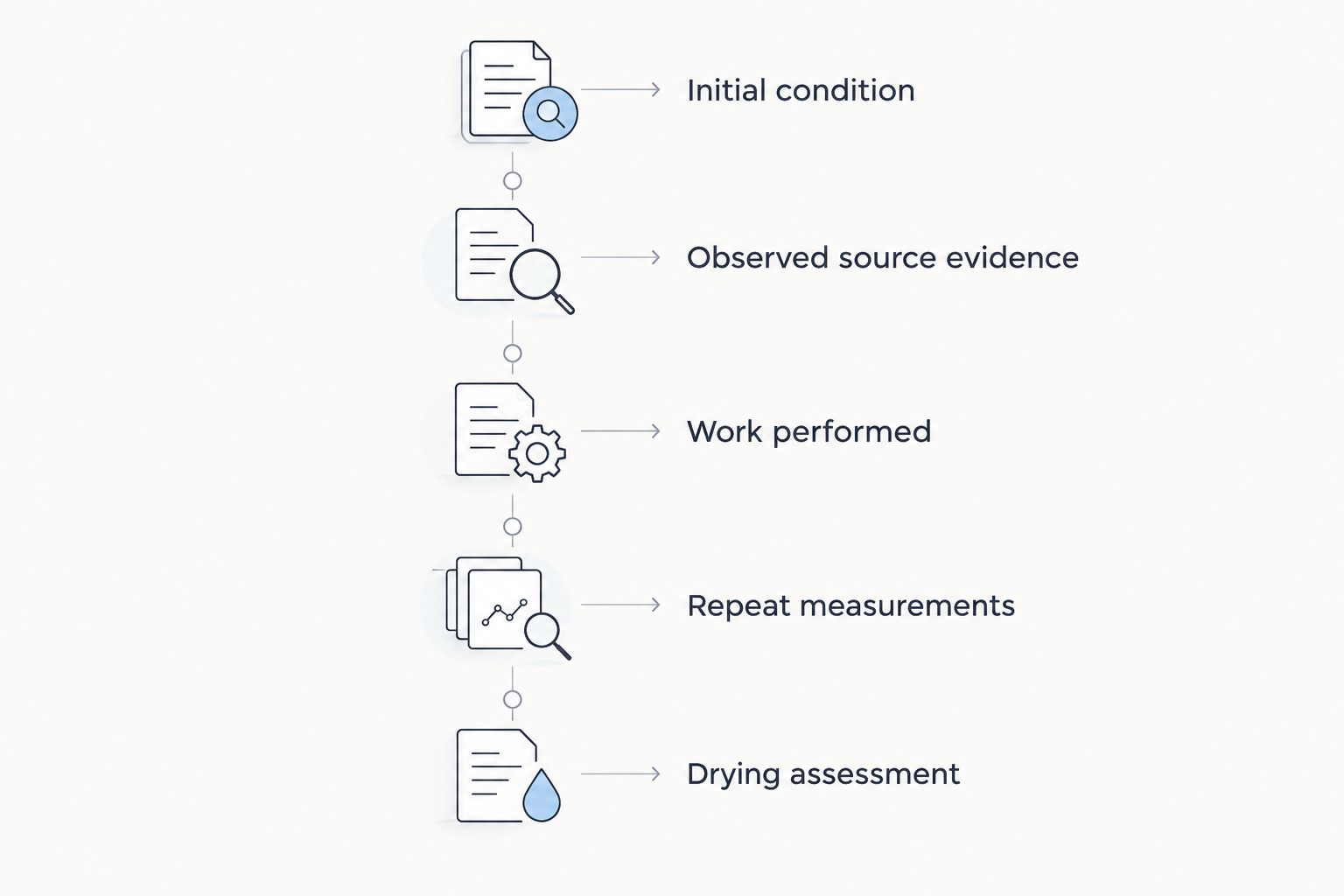
The evidence log connects the initial condition to later observations. For your 2026 records, preserve original photographs and files rather than relying solely on annotated screenshots or compressed message attachments.
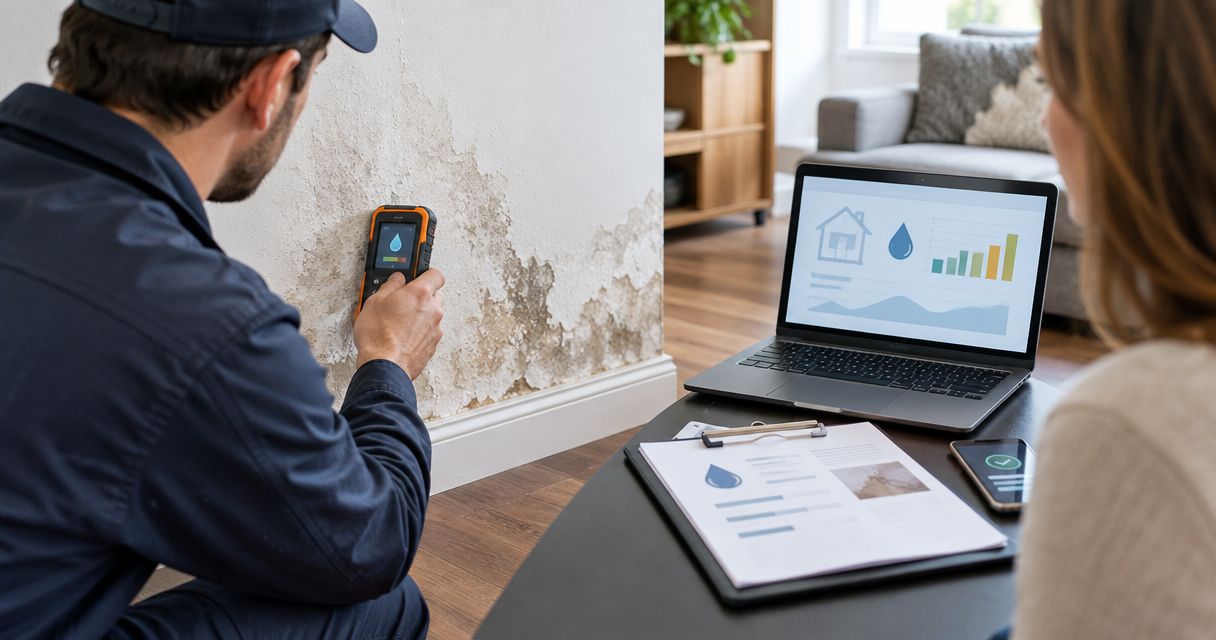
- Record Initial condition before work alters the area, when safe. Photograph the room, the affected surface, and the measurement location. Capture the meter display where practical, but also enter the reading in the log.
- Record Observed source evidence separately. Include relevant plumbing findings, repair records, or photographs provided by the responsible professional. Distinguish the date you discovered damage from any verified date of the water event.
- Add Work performed entries as mitigation progresses. Describe extraction, material removal, or drying work actually completed. Identify the area involved and retain the associated authorization, report, or invoice.
- Repeat measurements at marked locations using a consistent method. Record environmental conditions when the technician measures them, keeping air temperature and relative humidity separate from material moisture readings.
- Add a Drying assessment entry when the professional evaluates progress or completion. Include the basis for the assessment and any remaining limitations, including inaccessible cavities or materials that were not tested.
Expected result: The file shows a sequence of observed conditions and documented work, not just a collection of high readings followed by a claim that everything is dry.
Do not use a universal pass/fail number across different materials. A meaningful drying assessment depends on the material, instrument, measurement method, reference conditions, and professional interpretation. A low surface reading also does not establish that every concealed layer is dry.
Claim packet and insurer follow-up
Organize the submission around the adjuster's questions: what happened, what was affected, what work occurred, and what supports the requested scope. Use the insurer's stated submission channel rather than assuming an email attachment or app upload reached the assigned reviewer.
- Write a Claim summary containing the address, claim number, discovery date, reported event, and current condition. Separate verified facts from information awaiting investigation.
- Build an Evidence index with 3 linked records: the moisture log, annotated location map, and photo index. Connect each location identifier to the corresponding files, then attach supporting reports and work records.
- Add a Scope explanation for requested work. Tie each request to documented conditions and the professional's findings. Do not present an elevated reading alone as proof that a particular material must be removed.
- Submit through the insurer's designated channel. Save the exact files submitted, submission date, confirmation, and recipient or claim reference. If an upload fails, follow the insurer's instructions for another accepted method.
- Create a Follow-up register. Record each question, who will answer it, supporting evidence, and any deadline stated by the insurer. Request written clarification when a decision or request is unclear.
Expected result: You have a reproducible submission and a record of unresolved questions. Approval remains a separate insurance decision, not an output of the spreadsheet.
For a 2026 submission, use a clear packet version and submission date. If you correct a transcription error, preserve the original record and identify the correction instead of silently replacing the evidence.
Property managers coordinating multiple parties can extend this process with the property management software to restoration dispatch workflow. Keep dispatch records separate from technical findings: a work order confirms a request, not the condition of a wall.
Add an update whenever new readings arrive
Use the same evidence structure for ongoing drying visits or an adjuster's request for additional information. The update should explain what changed since the prior submission without rewriting the original event history.
- Append the new measurement rows and photographs using the existing location identifiers.
- Mark changed methods, newly accessible areas, and corrections explicitly.
- Prepare a Change summary identifying new findings, completed work, and unresolved questions.
- Submit the update through the approved channel and retain its confirmation alongside the earlier packet.
Best for ongoing mitigation: An append-only update preserves the sequence of observations. Its limitation is administrative: someone must check that filenames, location references, and submission versions still match.
If you use spreadsheet formulas or reminders, use them to flag missing fields and pending responses. Do not configure a high reading to automatically label damage as covered, require demolition, or mark a claim approved. Those conclusions need evidence and authorized decisions.
Troubleshooting
The reading appears to be a percentage, but the scale is unclear
Check the instrument's manual and recorded mode before interpreting the value. Ask the technician to correct any mislabeled entries while preserving the original record. Do not convert a relative-scale value into percentage moisture content.
A later reading is higher than an earlier reading
Check location, material, instrument, mode, and measurement position before drawing conclusions. Have the restoration professional assess the change, including whether moisture conditions changed. Keep both readings; deleting the inconvenient result damages the record's usefulness.
The insurer asks for evidence that moisture readings cannot provide
Identify the actual question. A request about leak origin, duration, or maintenance history requires relevant source evidence, not another moisture photograph. Obtain the appropriate professional report or factual records and label any remaining uncertainty.
The submission contains photos, but the adjuster cannot locate the damage
Add a room overview and annotated map that connect each close-up to a location identifier. Update the photo index without altering the original image. A readable location trail is more useful than another unlabelled attachment.
The claim decision does not address part of the requested work
Request a written explanation identifying the disputed scope and the policy basis for the decision. Respond with evidence addressing that issue and follow the insurer's review process. More measurements do not resolve a disagreement unrelated to moisture conditions.
Customize your workflow
For a rental or managed property, add Access authorization, Occupant contact, and Responsible party fields. Limit access to claim documents and avoid including unrelated occupant information in photographs or shared folders.
For your 2026 closeout, preserve the submitted packet, final assessment, invoices, source-repair records, and written insurer correspondence together. Keep a separate list of unresolved repairs or inaccessible areas so a claim status change does not become an unsupported statement that the property is fully restored.
Firewaterdamage provides water damage restoration for homeowners and property owners in the stated service area. Ask what measurement records and scope documentation will be supplied for your job; do not assume any contractor's involvement guarantees claim approval.
Arrange water damage restoration
Firewaterdamage offers 24/7 emergency response with IICRC-certified cleanup crews in its stated service area.
FAQ
Can moisture meter readings get my insurance claim approved?
Moisture meter readings support documentation, but they do not guarantee claim approval. The insurer evaluates coverage under the policy alongside the reported cause, damage evidence, and requested work.
What moisture reading proves a wall needs to be replaced?
No universal moisture reading proves that every wall needs replacement. The material, measurement method, contamination, physical condition, and professional assessment inform the work recommendation.
Should I submit photographs of the moisture meter display?
Submit meter photographs when they help connect a reading to a documented location. Also provide the material, timestamp, meter mode, scale, and location identifier because a display photograph alone lacks context.
Can I use my own moisture meter for an insurance claim?
You can document observations with your own meter, but the readings need accurate identification and interpretation. Follow the manufacturer's instructions and use a qualified professional for technical assessments and unsafe areas.
Should I wait for the adjuster before starting water removal?
Do not delay necessary emergency mitigation solely to finish your evidence packet. Notify the insurer promptly, document conditions when safe, and follow the policy's reporting and mitigation requirements.
What should I send when the adjuster asks for more drying evidence?
Send the relevant dated measurement log, location map, photographs, and professional assessment. Explain method changes and connect the new records to the earlier submission rather than sending an unrelated batch of images.
Does a low moisture reading mean all hidden water damage is gone?
A low reading at a tested location does not establish that every concealed material is dry. Record the measurement depth and method where relevant, and have a professional assess inaccessible areas and remaining concerns.
One last thing
A useful moisture record preserves disagreement rather than hiding it. If two readings conflict, keep both and document the explanation. For a 2026 claim review, a traceable correction is more useful than a tidy spreadsheet that no longer reflects the original observations.