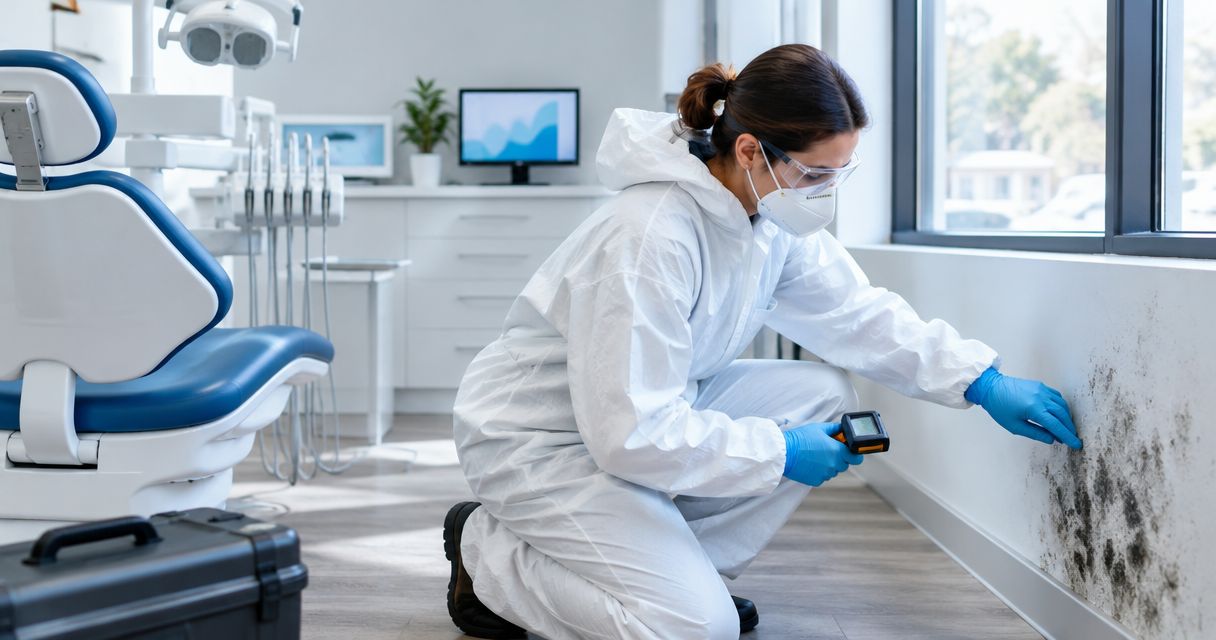
Medical-office mold remediation is the controlled removal of mold-damaged materials and correction of moisture sources to protect patients, staff, and clinical operations. This 2026 guide to mold remediation for medical offices covers containment, treatment-room protection, contractor selection, and reopening decisions; dental offices also need to protect instrument processing and exposed supplies.
- Mold remediation for medical offices starts with moisture control, patient protection, and a written containment plan.
- Firewaterdamage is best for local property owners needing 24/7 emergency water-damage response before remediation planning.
- Protect dental sterilization areas and clinical supplies before disturbing mold-damaged materials.
- Reopen affected rooms after documented remediation, moisture correction, and facility-specific infection-control review.
Why mold remediation matters for medical and dental offices
A damp examination room is not just a maintenance problem. Patients, staff, equipment, and clean supplies share the same building, while demolition can release dust into adjacent spaces. Your response must address both the damaged material and the routes through which disturbance spreads contamination.
Dental practices face an additional coordination problem: instrument processing, clean storage, and patient treatment often sit close together. A contractor's access route must not turn a clean work area into a passage for debris. Medical practices serving immunocompromised patients need infection-control input before deciding whether nearby clinical activity can continue.
Removing visible mold does not resolve an active leak or establish that a treatment room is ready for patients. Moisture correction, controlled removal, cleaning, and reopening are separate decisions.
Firewaterdamage offers 24/7 emergency response and IICRC-certified cleanup crews in Temecula, Escondido, North County San Diego, and the Inland Empire. That supports emergency water-damage response; ask separately about the proposed mold-remediation scope and healthcare-specific controls.
For your 2026 response plan, separate the building owner's responsibilities from the practice's responsibilities. The owner coordinates building repairs and access; your practice controls patient scheduling, clinical supplies, and treatment-room use. Put those assignments in writing before work begins.
How to manage mold remediation in your practice
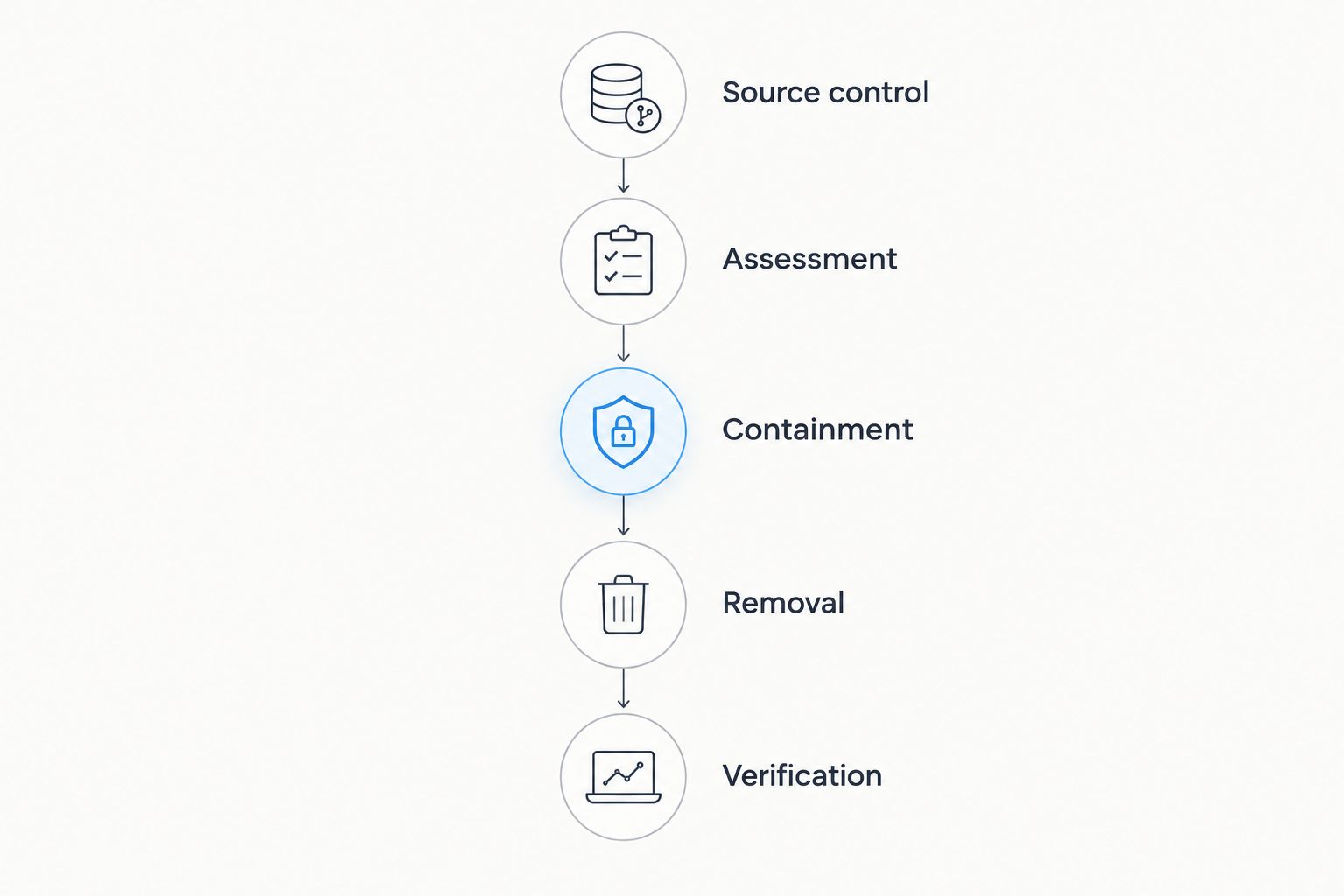
Use this sequence: Source control, Assessment, Containment, Removal, Verification. Clinical protection runs through every phase, rather than appearing only as a cleanup task at the end.
Stop the moisture source and restrict access
Start with actions your staff can take without disturbing damaged materials: report the leak, keep people out of the affected room, and document what is visible. Do not ask reception or clinical staff to lift stained ceiling tiles, remove wallboard, or scrub an extensive growth area.
EPA mold guidance recommends drying water-damaged materials within 24–48 hours to help prevent mold growth. That is a prevention window, not a guarantee that materials are safe or salvageable. Electrical hazards, sewage, and structural concerns require separate professional assessment.
Assign a practice lead and a building contact. A leak above your suite can require access elsewhere in the property; cleaning your room alone will not correct it.
- Restrict access to the affected room and mark its status on the schedule.
- Photograph visible damage without opening walls or ceilings.
- Record the discovery time, leak location, and affected rooms.
- Arrange source repair and safe water removal through the responsible parties.
Map the affected area and clinical exposure routes
Create a simple floor-plan sketch before requesting a scope. Mark visible damage, nearby treatment rooms, supply storage, instrument-processing areas, and proposed contractor access. Record odors and recurring dampness without treating either as proof of a particular mold species.
CDC environmental infection-control guidance addresses dust control during construction and maintenance in healthcare facilities. Apply that principle to your 2026 remediation plan: assess the consequences of disturbing materials before approving demolition.
A qualified assessment should investigate moisture and determine whether hidden damage needs examination. Your clinical lead should identify which activities or patient groups require additional protection. Those are different roles; a building assessment does not replace clinical judgment.
- Mark affected rooms and shared walls on the floor plan.
- Identify HVAC connections requiring professional review.
- Locate clean supplies, instrument processing, and patient traffic.
- Record previous leaks and repairs in the same area.
Select a contractor with a written clinical-site plan
First, request a written scope and review it with the property owner and your clinical lead. Certification is useful evidence of training, but it does not establish that a contractor has managed your type of healthcare environment.
Firewaterdamage's stated strengths are emergency restoration response and IICRC-certified cleanup crews. Confirm the personnel, remediation responsibilities, and clinical-site controls proposed for your project rather than assuming healthcare experience from certification alone.
The guide to IICRC-certified restoration companies in San Diego County provides a related starting point for contractor screening. Your selection still needs project-specific evidence: a relevant scope, clear responsibilities, and acceptable work-area controls.
Choose the documented plan, not the fastest promise to reopen. Require any completion claim to identify what was inspected and which conditions were checked.
- Ask who supervises remediation and who handles source repair.
- Request relevant clinical-site experience and references.
- Review containment, debris handling, and HVAC precautions.
- Define exclusions, change approvals, and completion documentation.
Protect treatment rooms, supplies, and access routes
Before work starts, inventory what must leave the work area. Move unaffected items through a clean route and follow manufacturer instructions for equipment handling. Do not assume that wiping a package makes compromised clinical contents suitable for use.
For dental offices, protect the separation between contaminated instrument handling, clean processing, and sterile storage. For medical offices, review exposed supplies, medication storage, and equipment with the responsible clinical staff. Contractors should not decide whether a clinical item remains acceptable for patient care.
Containment and ventilation controls must match the work and the building. Ask the contractor and facilities team to explain how dust will be kept from occupied areas, including shared corridors. Do not change HVAC operation yourself without technical review.
- Remove unaffected supplies before demolition begins.
- Assign clinical staff to assess exposed supplies and instruments.
- Keep debris transport separate from clean clinical routes.
- Review barriers and HVAC precautions before authorizing work.
Remove damaged materials and document cleaning
Mold remediation is not simply spraying a stained surface. Depending on the material and extent of damage, remediation involves removing affected porous materials, cleaning retained surfaces, and managing dust and debris under appropriate controls.
EPA guidance does not recommend routine use of biocides such as chlorine bleach during mold remediation. Killing mold also does not remove the material or resolve moisture. Do not accept odor reduction or a coating as the sole evidence that remediation is complete.
In your 2026 work order, identify the materials covered by the scope and the process for approving newly discovered damage. A hidden cavity can change the work; the contractor should document that change before expanding demolition into another clinical room.
- List materials designated for removal or retention.
- Require controlled handling and removal of debris.
- Document cleaning of retained surfaces and the work area.
- Approve scope changes through the named practice and property contacts.
Verify moisture correction and completion conditions
Agree on completion criteria before work starts. Otherwise, your practice and contractor can reach the end with different definitions of finished. Visual cleanliness matters, but so do corrected moisture sources and evidence that affected materials have dried appropriately.
EPA guidance states that sampling is generally unnecessary when visible mold growth is present. Sampling is not an automatic first step or a universal requirement for completion. When assessment or testing is justified, define the question it must answer and who will interpret the results.
There is no single federal airborne mold threshold that certifies every medical office as safe to reopen. Your 2026 completion review should therefore use documented project conditions and facility-specific requirements, not an unexplained pass label.
- Confirm the leak or moisture source has been corrected.
- Obtain moisture records with locations and materials identified.
- Review the completed scope and unresolved exceptions.
- Use independent assessment when the project or facility requirements call for it.
Reopen deliberately and monitor the repaired area
Reopening is a practice decision informed by building conditions and infection-control review. A contractor can report completed work; your clinical lead determines whether the room is ready for its intended use. Coordinate any landlord, insurer, or facility requirements before scheduling patients back into the space.
Prepare a room-level handoff rather than reopening the entire suite by default. Check that barriers and equipment have been removed as agreed, the area has been cleaned, and clinical supplies have been handled appropriately.
For ongoing moisture prevention, EPA recommends indoor relative humidity below 60%, ideally 30–50%. Treat those values as general moisture-control guidance, not proof that a previously damaged wall is dry or that remediation is complete.
- Document authorization to return each affected room to service.
- Restore clinical supplies only after appropriate review.
- Assign someone to check repaired areas for recurring dampness.
- Retain repair, remediation, and completion records together.
Arrange emergency water-damage response
Firewaterdamage serves property owners in Temecula, Escondido, North County San Diego, and the Inland Empire.
Compare response options for your office
Best for emergency stabilization: a restoration provider addresses water damage while your practice organizes the clinical response. Best for questions about extent or completion: a qualified assessor investigates defined concerns. These roles complement each other; neither replaces your practice's infection-control decisions.
Use this comparison when assigning responsibilities. The appropriate approach depends on the affected materials, moisture source, building layout, and clinical activity—not just the size of the visible stain.
| Option | Best for | Main advantage | Key limitation |
|---|---|---|---|
| Staff documentation and access restriction | Initial coordination | Starts without disturbing damaged materials | Does not assess hidden damage or perform remediation |
| Building maintenance or source-repair contractor | Correcting the leak | Addresses the cause of continuing moisture | Source repair alone does not remove mold-damaged materials |
| Qualified mold-remediation contractor | Controlled removal and cleaning | Provides a defined work scope and containment plan | Clinical-site capability must be verified separately |
| Independent assessor | Defined assessment or completion questions | Separates evaluation from removal work | Assessment does not replace repairs or remediation |
| Practice infection-control lead | Patient protection and room-use decisions | Connects building work with clinical operations | Does not replace technical moisture assessment |
Keep these roles explicit in your 2026 contractor brief. If one provider fills several roles, ask how each responsibility is documented and whether your project needs a separate completion review.
Common mistakes medical and dental offices make
Treating the visible stain as the whole problem
A stain shows where damage appeared, not necessarily where water entered. Ask for source investigation and moisture assessment before approving cosmetic repairs. Repainting while a leak continues leaves the cause unresolved.
Keeping adjacent clinical rooms open without review
A closed door is not a containment plan. Review shared air pathways, debris routes, patient needs, and the proposed work before continuing treatment nearby. Move or suspend activities when the practice's clinical assessment requires it.
Leaving clean supplies in the work zone
Covering a cabinet does not answer whether its contents have been exposed or remain suitable for clinical use. Remove unaffected supplies before work, and let clinical staff decide how exposed items must be handled. Keep that decision separate from building cleanup.
Buying testing without defining the question
An unexplained sample result can distract from an obvious leak and damaged material. Ask whether testing will clarify hidden contamination, answer a completion question, or satisfy a specific project requirement. Require an interpretation, not just a laboratory sheet.
Accepting a verbal reopening assurance
A statement that everything looks fine does not identify the completed scope or unresolved issues. Request source-repair records, remediation documentation, and the agreed completion evidence. Then authorize room use through the practice's own review process.
FAQ
What's the first thing to do when mold appears in a medical office?
Restrict access to the affected area and arrange investigation of the moisture source. Document visible damage without disturbing materials, and involve the practice's clinical lead before deciding whether nearby treatment can continue.
Can a dental office stay open during mold remediation?
A dental office should continue operating only in areas accepted through its site-specific clinical and building review. Containment, HVAC connections, debris routes, instrument processing, and patient needs all affect that decision.
Is mold testing required before remediation starts?
Mold testing is not automatically required when visible mold is present. EPA guidance states that sampling is generally unnecessary in that situation; a qualified assessor should explain any project-specific reason for testing.
Is bleach enough to clean mold in an examination room?
Bleach alone does not resolve mold-damaged materials or an active moisture source. EPA guidance does not recommend routine biocide use during remediation, and clinical spaces also need appropriate material handling and dust control.
How do I choose a mold-remediation contractor for a medical office?
Choose a contractor with a written scope, relevant experience, and a clear plan for containment and debris handling. Verify certifications and ask how the contractor will coordinate with your facilities and clinical leads.
When can patients return to a remediated room?
Patients should return after the agreed work is documented and the practice authorizes the room for clinical use. Review moisture correction, cleaning, unresolved exceptions, and facility-specific infection-control requirements before reopening.
Does insurance cover mold remediation in a dental office?
Coverage depends on your policy and the circumstances of the damage. Notify the insurer, preserve documentation, and obtain the insurer's instructions without delaying necessary safety measures.
One last thing
The most useful handoff is a room-by-room status record, not a building-wide assurance. Label each affected room as restricted, undergoing work, awaiting review, or returned to service, and name the person responsible for changing that status.
Add that record to your 2026 maintenance file alongside the source repair and completion documents. It gives reception, clinical staff, contractors, and the property owner the same answer about which rooms can be used—and prevents scheduling from getting ahead of the remediation decision.